
A Guide to Caring for Grand Pianos
- Toby Johnson
- 1 day ago
- 6 min read
A grand piano can look serene while quietly reacting to everything around it. A week of dry central heating, strong afternoon sun across the case, or an enthusiastic attempt at polishing can all leave their mark long before the instrument appears to have a problem. That is why a proper guide to caring for grand pianos begins not with products, but with understanding how sensitive these instruments are to their environment.
Unlike many pieces of furniture, a grand piano is a living assembly of timber, felt, leather, steel and finely regulated mechanical parts. Its soundboard expands and contracts with changes in humidity. Its action depends on tiny tolerances for consistency of touch and repetition. Even when played gently and kept clean, it will drift out of tune over time because string tension is constantly settling against a wooden structure under immense load.
For owners, families, schools and venues alike, good care is less about fuss and more about steadiness. The aim is to give the instrument a stable life so that its tone remains singing, its touch remains dependable, and avoidable wear is kept to a minimum.
Guide to caring for grand pianos at home
The single most important decision is where the piano lives. Placement has a direct effect on tuning stability, finish condition and the long-term health of the structure. A grand should be positioned away from radiators, underfloor heating zones, open fires and direct sunlight. External walls can also be troublesome if they are especially cold or damp, while south-facing glazing may expose the case and soundboard area to sharp daily temperature swings.
This does not mean a grand piano must be hidden away in a dark corner. It means choosing a space with moderate, predictable conditions. If the room is comfortable for people throughout the year, that is usually a sensible starting point. Trouble tends to come from extremes rather than normal domestic life.
Humidity matters more than many owners realise. Very dry air can cause shrinking in timber components, loosen joints and make tuning less stable. Excess moisture can encourage swelling, sluggish action parts and corrosion. In the South East of England, seasonal shifts between damp winters and dry heated interiors can be enough to unsettle a piano noticeably. If the room suffers from pronounced seasonal swings, it is worth addressing the environment rather than waiting for recurring musical symptoms.
Cleaning a grand piano without causing damage
Most cosmetic damage is done with good intentions. The case finish, key surfaces and internal components all need a different approach, and heavy-handed cleaning is rarely helpful.
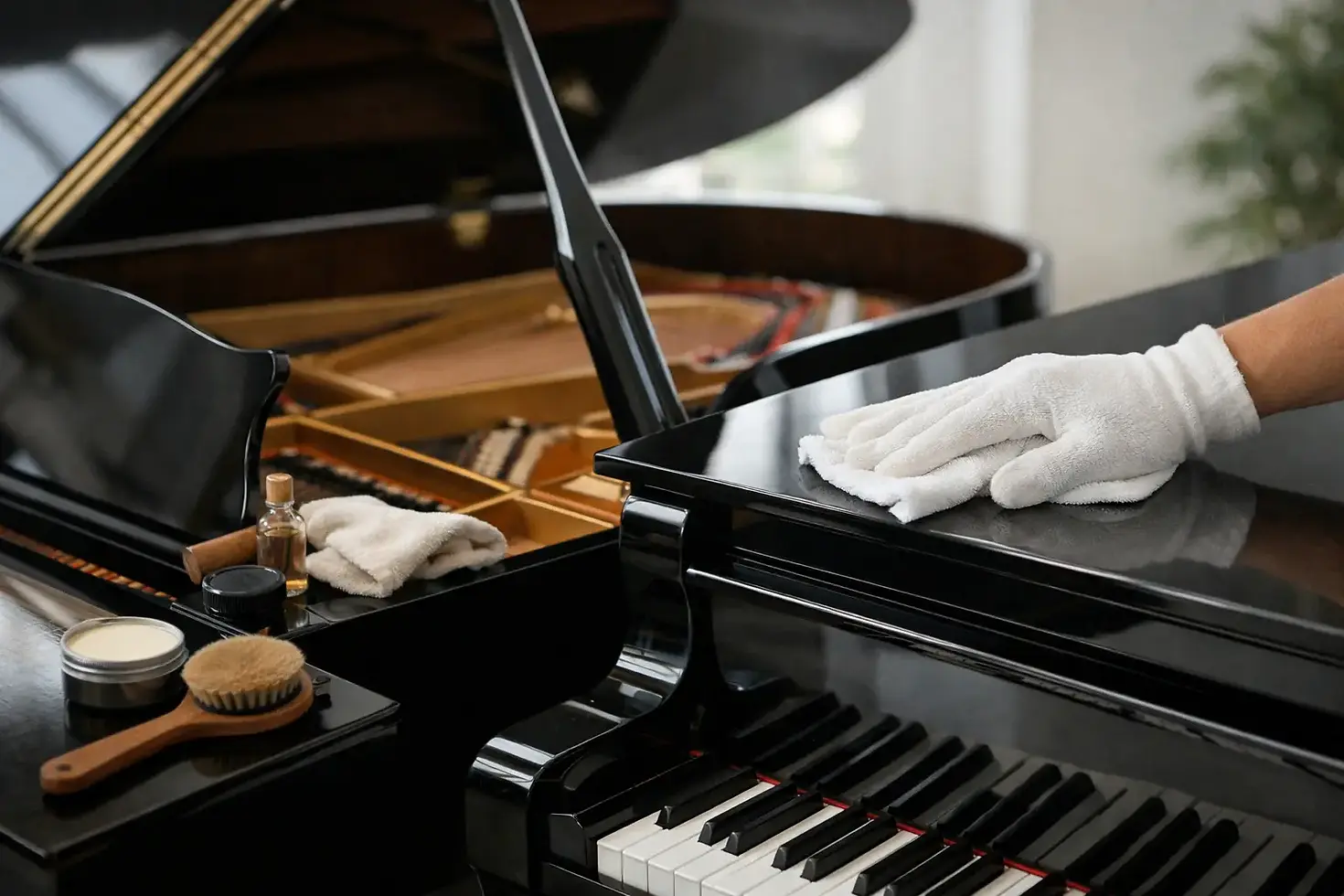
Dusting the case with a clean, dry microfibre cloth is usually sufficient for routine care. If there are fingerprints or light marks, use a slightly damp cloth followed immediately by a dry one, taking care not to leave moisture sitting on the finish. Household sprays, silicone polishes and general-purpose cleaners are best avoided unless you know they are suitable for that exact finish. What looks glossy in the moment can leave residue, streaking or long-term surface problems.
Keys should be wiped gently with a soft cloth, working from the back of each key towards the front so that moisture is not pushed between them. A barely damp cloth is enough. Overwet cleaning can allow moisture to enter the keyframe or keytops, which creates its own complications.
Inside the piano, restraint is wise. Dust on visible surfaces may tempt an owner to clean beneath the lid, but the action, strings and dampers are not areas for casual household maintenance. It is easy to bend something, disturb regulation or leave fibres caught where they should not be. If the interior needs more than a careful light dust of accessible areas, it is usually a task for a technician.
Tuning is essential, but it is not the whole story
Many people think of piano care as tuning and little else. Tuning is certainly essential, but a grand piano’s performance also depends on regulation and voicing. These are separate aspects of maintenance, and they shape the musical experience just as much.
Tuning adjusts pitch. Regulation concerns the mechanical relationship between keys, hammers, repetition parts and dampers, so that the touch is even and controllable across the keyboard. Voicing refines tone by addressing the condition and behaviour of the hammer felt. If a piano sounds bright in one area, dull in another, or feels uneven under the fingers, tuning alone may not solve it.
How often a grand should be tuned depends on its use, its environment and its musical demands. A domestic instrument played regularly will still need routine tuning because time and seasonal change affect every piano. A school, teaching studio or performance instrument may require more frequent attention simply because it is worked harder and expectations are higher. A newly moved piano, or one adjusting to a different room, may also need closer observation for a period.
The key point is consistency. Leaving a piano for too long between services often creates more work for the instrument and a less satisfying result for the player. Regular expert attention keeps the piano closer to its proper condition rather than allowing several smaller problems to gather.
Everyday habits that protect tone and touch
A well-kept grand benefits from quiet routines. Keep the lid closed when the instrument is not in use, particularly in busy family spaces or venue settings where dust, sunlight and accidental knocks are more likely. Use the fallboard carefully rather than dropping it shut. Avoid placing drinks, vases, framed photographs or candles on the case. Apart from the risk of spills and heat damage, even small decorative items can mark the finish over time.
Playing the instrument regularly is actually beneficial. A grand piano that sits untouched for long periods may still deteriorate, and sometimes in less obvious ways. Action centres can stiffen, felt can compact unevenly, and minor issues may go unnoticed until they are more advanced. Regular use keeps the mechanism active and gives you a better sense of when something has changed.
That said, vigorous playing from developing students can expose wear more quickly, especially if the piano is used for daily practice. This is not a reason for concern, only a reminder that heavier use should be matched by appropriate maintenance. A grand built for musical life wants to be played, but it also wants to be looked after properly.
When small warning signs should not be ignored
Grand pianos rarely fail all at once. More often, they begin to offer subtle signs that something is shifting. A note may start to ring on slightly after release. A key may feel heavier than its neighbours. The pedal may develop noise or extra travel. You may hear a new buzz, a metallic edge, or a patch of tuning that seems to move more quickly than the rest.
These symptoms do not always indicate serious structural trouble, but they do warrant attention. The longer minor faults are left, the more likely they are to affect adjacent parts or become harder to correct neatly. A sticking key, for example, may be caused by a modest change in regulation or humidity, but if ignored it can interfere with practice, teaching or performance and conceal a wider issue.
This is where experienced assessment matters. Good piano care is not simply reactive; it is diagnostic. A technician is not only there to correct faults, but to distinguish between ordinary seasonal behaviour, maintenance needs and genuine developing problems.
Moving, covering and long-term protection
If a grand piano needs to be moved, even within the same building, caution is essential. These instruments are heavy, structurally complex and surprisingly vulnerable to poor handling. Legs, lyres and casework can all be damaged by improvised moving. More importantly, rough handling can affect the internal setup in ways that are not always visible at once.
After any move, allow the piano time to settle before expecting it to hold tune perfectly. A change of room, floor, temperature or humidity can alter how the instrument behaves for a while.
Protective covers can be useful in some settings, especially in venues, schools or rooms that are not in constant use, but they are not a substitute for a healthy environment. A cover helps with dust and light contact. It does not solve underlying damp, excessive dryness or heat exposure.
A long view of grand piano care
The best guide to caring for grand pianos is really a guide to consistency. Keep the environment stable, clean the instrument gently, arrange regular professional servicing, and pay attention when the piano tells you something has changed. Grand pianos respond remarkably well to thoughtful ownership. Given the right conditions and expert care, they do not simply remain serviceable - they become more satisfying to live with, play and listen to over many years.
If you treat a grand piano as both a musical instrument and a finely made mechanism, it will reward you with far more than reliability. It becomes part of the life of the room, ready whenever music is needed.


Comments