


Choosing a Piano Sourcing Service in the UK
A piano may look handsome in a photograph, carry a respected name on its fallboard and still be the wrong instrument to bring home. Its musical life is determined by matters that cannot be judged at a glance: the evenness of its touch, the stability of its tuning, the condition of its action, the soundboard’s health and the quality of previous care. A piano sourcing service UK buyers can rely on brings these questions into the open before a decision is made.
For a family choosing a first proper piano, a returning adult player or an experienced musician seeking a more expressive instrument, sourcing is not simply a search for availability. It is a careful matching exercise. The aim is to find a piano with genuine musical potential, appropriate dimensions and dependable mechanical condition, while avoiding an instrument whose apparent appeal conceals costly or limiting faults.
What a piano sourcing service in the UK should provide
A specialist sourcing service begins with listening. The right piano for a child beginning lessons may be very different from the right piano for a diploma student, a teacher or a home where several people play. Room size, neighbouring properties, existing furniture, how often the instrument will be used and the player’s musical ambitions all shape the recommendation.
There is also the question of whether an upright or grand piano is suitable. An upright can offer excellent musical results and is often the sensible choice where space is limited. A grand piano may provide greater tonal range and control, but only when the room, acoustics and player’s requirements justify it. Bigger is not automatically better. A carefully chosen smaller instrument with a responsive action can be more rewarding than an imposing piano that has been neglected.
A good sourcing service will establish a clear brief, identify suitable instruments from appropriate channels and assess each serious candidate in person. It should offer impartial advice about condition and suitability, rather than simply encouraging the quickest purchase.
Why inspection matters more than appearance
Pianos are complex instruments built from timber, felt, leather, metal and finely regulated moving parts. They respond to temperature, humidity, use and long periods of inactivity. A glossy cabinet and clean keys may be encouraging, but they tell only a small part of the story.
The structure and tone
The frame, strings, bridges and soundboard must be examined for signs of concern. Some age-related markings are entirely normal and do not necessarily affect musical value. Others can point to structural strain, instability or a restricted tonal future. The piano should be played across its whole compass to assess the clarity, sustain and consistency of tone.
A discerning assessment also considers whether the instrument speaks evenly from bass to treble. Some variation of character is natural, particularly in older pianos, but abrupt changes in volume or colour can make expressive playing difficult. The question is not whether a piano is flawless, but whether its condition supports the music it is intended to make.
The action and touch
The action is the mechanism connecting the key to the hammer that strikes the string. Its regulation has a direct effect on control, repetition and comfort. Sticky notes, uneven key weight, poor repetition or excessive noise can be symptoms of wear, incorrect adjustment or long-deferred maintenance.
A piano should feel predictable beneath the hands. For a beginner, this supports good technique from the outset. For an advanced player, it permits finer control of voicing, phrasing and dynamics. An expert inspection distinguishes between work that is straightforward servicing and signs that the action has reached the limits of what sensible repair can achieve.
History and provenance
Where possible, it is useful to understand where a piano has lived and how it has been maintained. An instrument kept in a stable, regularly used domestic environment may have had a very different life from one stored for years in a cold outbuilding or exposed to damp conditions. Service records can be helpful, although their absence does not automatically rule out a piano.
What matters is that the current condition is assessed honestly. A specialist should explain both the piano’s strengths and its limitations in plain language, allowing the buyer to make a considered choice.
Matching the piano to its new home
Musical suitability and practical suitability belong together. Before a piano is selected, it is worth considering access to the property, staircases, floor level and the route from vehicle to room. Professional piano movers can advise on challenging access, but it is far better to identify potential complications early than to discover them on delivery day.
The room itself matters too. A piano placed beside a radiator, external door or persistently damp wall is more likely to suffer tuning instability and changes in regulation. Direct sunlight can affect the cabinet and contribute to uneven temperatures. The best position is usually an internal wall away from heat sources and strong draughts, with a reasonably stable environment throughout the year.
For households where quiet practice is essential, a suitable retrofit silent system may be worth considering. This is not a substitute for choosing a piano with a satisfying acoustic voice, but it can make regular practice possible when other people are working, studying or sleeping nearby. The decision depends on how the piano will actually be used, not on a feature list.
A considered route to the right instrument
The strongest sourcing process is deliberate rather than hurried. After discussing the brief, a specialist narrows the field to instruments that merit attention. This saves buyers from spending weekends trying pianos that are unsuitable on size, condition or musical character alone.
When a promising piano is found, the assessment should cover its present playing condition as well as its likely requirements after installation. A piano can be prepared carefully before delivery, but it will still need time to settle into a new environment. A tuning after it has acclimatised is a normal part of responsible ownership, particularly after a move or during a marked seasonal change.
For buyers in Woking, Guildford, Godalming and the surrounding areas, working with a local specialist also offers continuity. The person who helps select the instrument can remain available to tune, regulate and care for it over the years. That continuity is valuable because a piano’s performance develops through regular, informed maintenance.
When refurbishment is the better choice
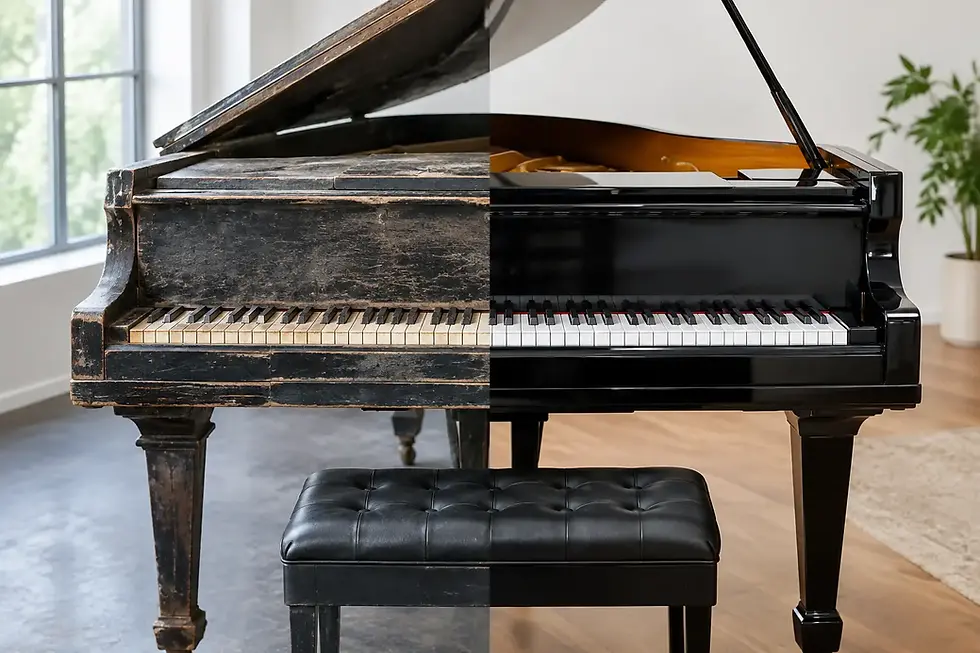
A carefully refurbished piano can represent an excellent option, provided the work has been carried out to a proper standard and the instrument is selected for its underlying quality. Refurbishment is not a single, uniform description. It may range from thorough cleaning and regulation to more substantial work on the action, strings, pins and cabinet.
The essential question is whether the work has restored reliability and musical usefulness, rather than merely improving presentation. An honest specialist will be clear about what has been done, what remains original and what ongoing care the instrument will need. This gives the buyer a realistic understanding of the piano they are choosing.
Conversely, there are occasions when an attractive older piano should be left alone. If structural condition, action wear or lack of musical response makes it a poor candidate, sentiment and surface appearance should not outweigh judgement. Walking away is sometimes the most valuable advice a sourcing professional can give.
A piano worth living with
The finest choice is rarely the one that makes the strongest first impression for five minutes. It is the piano that continues to invite practice, supports musical progress and remains dependable through ordinary family life. It should feel right under the hands, suit the room and have a future that is understood from the beginning.
At Runnymede Pianos, sourcing is approached with that long view in mind: careful selection, straightforward advice and respect for the instrument’s musical potential. Give the search enough time, listen with your own ears and let expert inspection guide the final decision. A well-chosen piano can become part of a home’s life for many years.

Comments