


Restoring Old Pianos with Care and Judgement
A piano that has stood quietly in a family home for decades can hold far more than dust and faded polish. It may carry childhood lessons, a relative’s playing, or the promise of music returning to a room. Yet restoring old pianos is not simply a matter of making an instrument look presentable again. The right work must respect its history while addressing the parts that determine whether it can sound, feel and remain dependable as a musical instrument.
A fine restoration can give a worthwhile piano many more years of service. Equally, a sensitive assessment may show that limited repairs, regular tuning and careful maintenance are the wiser course. The aim is not to make every old piano look new. It is to make an honest judgement about what the instrument can become.
Why an old piano needs a proper assessment
Age alone does not decide whether a piano merits restoration. Some modest instruments have survived remarkably well because they have lived in stable, dry homes and been maintained with care. Others may have suffered significant deterioration after years beside a radiator, in a damp outbuilding or through long periods without tuning.
The make, model, construction, condition and musical potential all matter. A technician will consider the soundboard and bridges, the iron frame, the strings and tuning pins, the action, the keyboard, pedals, casework and evidence of previous repairs. The piano’s original quality is also relevant. A beautifully made instrument with a tired action may be an excellent restoration candidate; a poorly built instrument with extensive structural problems may never justify major intervention.
This is why an inspection should begin with careful listening as well as looking. Does the piano retain a pleasing tonal character beneath its faults? Is the touch fundamentally sound? Are there signs of woodworm, loose glue joints, cracked structural components or severe rust? A piano is a complex system, and a weakness in one area often affects another.
Restoring old pianos is more than a cosmetic project
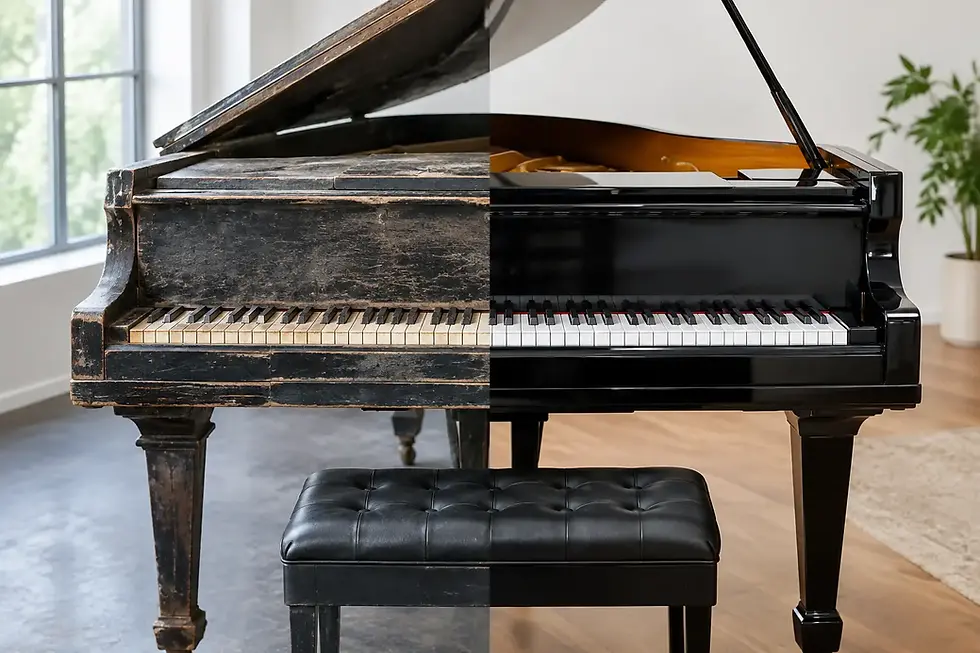
The most visible part of a restoration is often the cabinet. Scratched veneers, faded finishes and damaged mouldings can be repaired or refinished with great skill. This work has real value, particularly where the piano is an important piece of furniture or has family significance. But a gleaming cabinet does not guarantee a satisfying instrument.
The musical mechanism is where restoration earns its value. The action contains thousands of precise moving parts, including hammers, shanks, flanges, dampers, levers and felt components. Over time, felt compresses, leather hardens, wood dries, centres become tight or loose, and regulation falls out of adjustment. The result may be uneven response, sticking notes, poor repetition, excessive noise or a touch that feels heavy and unresponsive.
Restoration may involve rebuilding or reconditioning elements of the action, replacing worn components where appropriate, regulating each key to work consistently, and carefully voicing the hammers. Regulation concerns the movement and timing of the mechanism. Voicing shapes the tone by working with the hammer felt so that the sound is balanced, clear and musical rather than harsh or dull. These are different disciplines, and both affect the player’s experience every time a key is pressed.
The piano’s strings and tuning stability also require particular judgement. Old strings may be corroded, false-sounding or prone to breaking. Tuning pins may no longer hold securely in the pinblock. Replacing strings or carrying out more extensive structural work can transform an instrument, but it is substantial work that should only be undertaken when the piano’s foundation is sound and its musical quality merits it.
Restoration, repair or sympathetic preservation?
There is no single correct level of intervention. For some family pianos, sympathetic preservation is the most appropriate path. The cabinet may retain its gentle signs of age, while the keyboard, pedals and action receive the attention needed to make the piano reliable for home playing. This keeps the instrument’s character intact without treating it as a showroom object.
For a piano intended for serious study, teaching or regular performance, more comprehensive mechanical work may be justified. Consistency of touch, stable tuning and dependable repetition become practical requirements, not luxuries. A school or teaching studio, for example, needs an instrument that responds predictably to different players throughout the day.
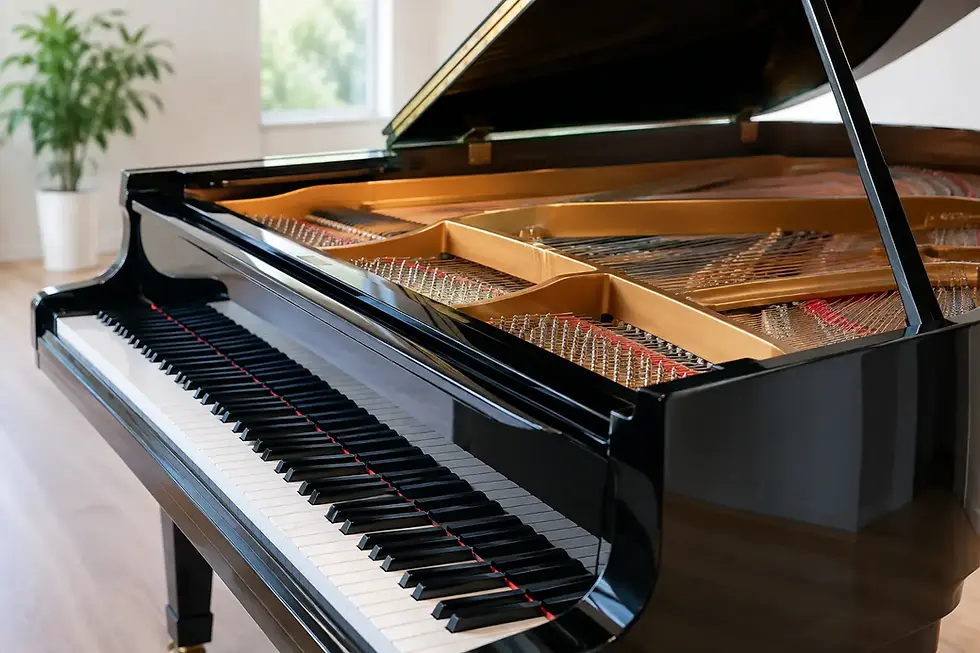
Then there are pianos of particularly high original quality, distinctive design or significant personal value. These may warrant a full restoration undertaken in stages and to a carefully agreed brief. The objective should always be clear: perhaps to return a cherished grand piano to family use, prepare an instrument for advanced playing, or preserve a period cabinet while achieving a more dependable action.
A reputable specialist will explain the likely outcomes and limits plainly. Restoration can improve tone, touch, appearance and reliability, but it cannot turn every old upright into a concert instrument. Honest advice protects both the piano and its owner.
What a thoughtful restoration process looks like
Good work begins with a detailed condition report. This establishes what is urgent, what is desirable and what may sensibly wait. It also allows the owner to understand the relationship between cosmetic improvements and the mechanical work needed for musical performance.
Once a course is agreed, the piano may be worked on in the home for smaller repairs and regulation, or taken into workshop conditions for more extensive action, keyboard or cabinet work. Stable humidity, appropriate tools and time for precise adjustment are essential. Fine piano work is rarely hurried. A change to one component can alter the behaviour of several others, so the instrument must be assessed and adjusted repeatedly as work progresses.
After rebuilding or significant repairs, the piano will need tuning and settling. New strings, hammers and felt parts take time to bed in, while timber responds gradually to its environment. Follow-up regulation and tuning are often part of achieving a genuinely finished musical result rather than merely completing a repair.
The role of the piano’s environment
Even the finest restoration cannot overcome a damaging environment indefinitely. Pianos are made largely from wood, felt and metal, all of which respond to changes in temperature and humidity. Central heating, underfloor heating, direct sunlight, external walls and open fires can create conditions that place the instrument under continual stress.
A piano should be positioned away from radiators and obvious draughts, with reasonable consistency in the room’s climate. It should also receive regular tuning, even if it is not played frequently. Routine visits allow developing issues to be corrected before they become more serious and help preserve the careful work already carried out.
This is especially relevant in older properties across Surrey and the wider South East, where a piano may be placed in a charming but changeable room. A specialist can advise on positioning and ongoing care without asking an owner to make their home feel like a museum.
Questions to ask before committing to major work
Before authorising restoration, ask what the piano will be used for and what success would look like. A family wanting occasional playing has different needs from an advanced pupil preparing for examinations or a venue requiring an instrument for regular events.
It is also sensible to ask which work is essential for safety and reliability, which work will improve musical performance, and which elements are primarily cosmetic. Request a clear explanation of the instrument’s strengths, weaknesses and likely long-term maintenance needs. The best recommendation is not always the most extensive one; it is the one aligned with the piano’s potential and your relationship with it.
Photographs and a brief history can be useful, but they do not replace an in-person assessment. The feel of the keys, the stability of the structure and the character of the sound must be experienced directly.
A piano worth hearing again
An old piano should not be dismissed because it is dusty, out of tune or cosmetically tired. Nor should sentiment alone lead to unnecessary work. With expert care and sound judgement, many instruments can return to active musical life with a depth of character that newer pianos do not always possess.
If a piano has meaning in your home, begin with a thorough appraisal rather than assumptions. A considered recommendation can reveal whether it needs modest attention, careful preservation or a fuller restoration - and give its next chapter the musical quality it deserves.

Comments