


What to Check When Buying a Used Piano
A used piano can look beautiful in a sitting room and still be a poor musical investment. Equally, a modest-looking instrument can turn out to be stable, responsive and deeply satisfying to play. That is why knowing what to check when buying a used piano matters so much. You are not simply buying furniture. You are choosing a mechanical, acoustic instrument whose condition affects touch, tone, reliability and long-term usefulness.
For many buyers, the difficulty is that the most important issues are not always obvious at first glance. Polished cabinets and tidy brasswork can distract from worn action parts, tuning instability or a tired soundboard. A sensible purchase begins with the understanding that appearance, while relevant, comes some way behind musical and structural condition.
What to check when buying a used piano first
The first question is straightforward: does the piano have a tone and touch you actually want to live with? If the answer is no, the rest is academic. Sit down and play slowly across the full keyboard. Listen for evenness rather than brilliance alone. A good used piano should not produce a handful of pleasing notes and a great many thin, harsh or lifeless ones.
Pay attention to the bass, middle and treble separately. The bass should have some depth and warmth, not just a dull thud. The middle register ought to sing clearly, as this is where much everyday playing lives. The treble should feel clean and controlled rather than brittle. Some older pianos have charm and character, but character is not the same as unevenness. If one section sounds detached from the rest of the instrument, further inspection is needed.
The touch matters just as much. Keys should move consistently under the fingers, returning promptly and without hesitation. If some keys feel heavy, sluggish or shallow, there may be wear in the action or regulation issues that need attention. A beginner may not notice this immediately, but over time an uneven action makes practice harder and can limit progress.
Look beyond the cabinet
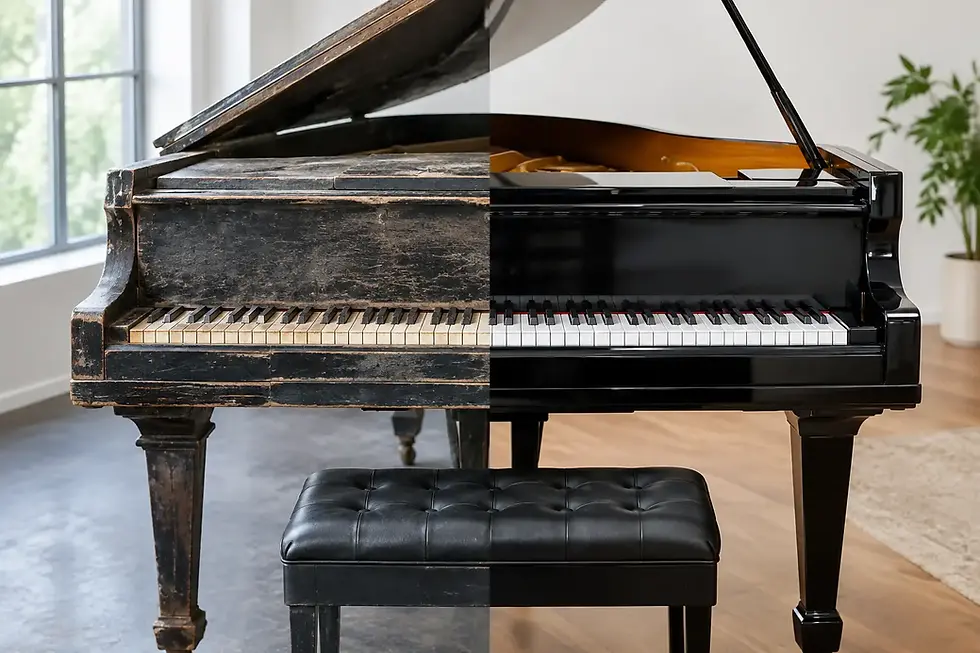
A tidy case can suggest a piano has been cherished, but cosmetic condition should never be mistaken for technical condition. Small scratches and marks are often less important than the state of the wrest plank, strings, bridges and action. In fact, some excellent older pianos show honest signs of age on the outside while remaining musically strong.
Open the top and lower panels if possible. Inside, you want to see an instrument that has been kept reasonably clean and dry. Excessive dust, signs of damp, rust on strings or fittings, and evidence of woodworm or moth damage in the felt all suggest neglect or poor storage conditions. A piano is sensitive to its environment. If it has spent years in a damp outbuilding or directly against a radiator, problems may follow even if it still appears presentable.
Cracks are not all equally serious, which is where experience helps. Small cosmetic marks in the cabinet are one thing. Structural issues in key internal components are another. Splits in bridges, loose tuning pins or obvious soundboard concerns deserve proper assessment before any decision is made.
The tuning pins and tuning stability
One of the most important things to check when buying a used piano is whether it is likely to hold its tuning. A piano that cannot remain stable is frustrating to own, however attractive it may seem initially. Ask when it was last tuned and whether it has been maintained regularly.
If the piano is severely flat or sharp, that does not always mean it is beyond saving, but it raises questions. Sometimes an instrument has simply been neglected for years. Sometimes it points to deeper instability. Loose tuning pins are a particular concern because they affect the piano's ability to stay at pitch. This is not something most buyers can judge confidently by eye, which is why an independent inspection is often worthwhile.
Do not assume that because a piano can be tuned once, it will then behave well. Stability over time is what matters.
Check every note and every key
It sounds obvious, yet many people try only a few favourite passages and make a decision too quickly. Play every note individually. Then play repeated notes, soft notes and louder chords. You are listening and feeling for consistency.
Each key should work cleanly, with no sticking, clicking, double striking or failure to sound. Pedals should operate properly and return as they should. If notes buzz, ring oddly or fail to dampen, the cause may be minor or more involved. The point is not to panic at every fault, but to notice patterns. One small issue can be repairable. A long list of problems usually indicates deferred maintenance.
On an upright piano, watch whether the keys sit at a reasonably even height. On a grand, observe whether the repetition feels responsive and controlled. An action that has lost precision can make the instrument feel tiring or unreliable, especially for advancing students and experienced players.
The action tells you how the piano has lived
The action is the heart of the piano's playing mechanism. It contains numerous moving parts, many of them covered in felt, leather and cloth, all of which wear over time. In a used piano, the action often reveals more than the cabinet ever will.
Worn hammer felts can suggest many years of use, particularly if grooves are deeply cut where the strings strike. Some wear is normal, and not every older action is a problem, but heavy wear can affect tone and control. Likewise, centres can become tight or loose, leading to sluggishness or noise. Regulation may drift gradually, leaving the piano harder to play evenly.
This is where there is a genuine trade-off. A heavily played piano from a respected maker may still be worth considering if the underlying build quality is strong and the work required is sensible. By contrast, a lightly used but poorly built instrument may never offer satisfying musical results. Age alone is not the deciding factor. Condition, design and previous care all matter more.
Consider age, but do not judge by age alone
Buyers often ask for a simple rule about how old is too old. In practice, it depends entirely on the piano. Some older instruments remain excellent because they were well made and carefully maintained. Others decline much earlier through neglect, unsuitable environment or weak original construction.
Try to learn the make, serial number and approximate age. Ask whether major restoration has been carried out and by whom. Honest, well-executed restoration can extend the useful life of a fine piano significantly. Poor work, however, can create fresh problems or disguise old ones.
An older piano should never be bought on sentiment alone. A family home may suit a characterful instrument with a warm, mellow tone. A serious student may need cleaner repetition and firmer control. The right choice depends on the player's needs, not just the romance of polished wood and history.
Room, placement and musical purpose
A piano does not exist in isolation. Before buying, think carefully about where it will live and who will use it. A tall upright with a powerful tone may be excellent musically, but too dominant for a small, lively room. A smaller instrument may fit the space better, but perhaps not offer enough depth for an advanced pianist.
If the piano is for a child beginning lessons, reliability and consistency matter more than decorative appeal. If it is for a teaching studio or regular entertaining, a broader dynamic range and better projection may be needed. For many homes, the best used piano is the one that encourages regular playing without overwhelming the room or demanding constant compromise.
This is also why local, specialist guidance can be valuable. In areas such as Surrey and London, many buyers are choosing between private sales, inherited pianos and dealer instruments, all with very different levels of accountability and preparation.
Ask the right questions before you commit
A seller does not need to be a technician, but they should be able to tell you something meaningful about the piano's history. Ask how long they have owned it, how often it has been tuned, whether it has been moved recently, and whether any repairs have been carried out. Vague answers are not always a warning sign, but good documentation and a clear maintenance history are reassuring.
Private sales can sometimes offer perfectly good instruments, but they also involve more uncertainty. A specialist business such as Runnymede Pianos will typically inspect, prepare and stand behind the pianos it offers, which changes the level of risk considerably. That is often the real difference - not just the piano itself, but the quality of expertise behind the recommendation.
If you are considering a private purchase, arranging an independent inspection is often the most prudent step. It can confirm whether a piano is fundamentally sound, whether hidden work is likely to be needed, and whether the instrument suits your aims musically.
What to check when buying a used piano if you are unsure
If you are in doubt, trust your uncertainty. A used piano should not leave you relying on hope. It should give you confidence in its sound, touch and condition. The best instruments tend to feel coherent - nothing jars, nothing seems oddly compromised, and the piano invites you to keep playing.
That is usually the clearest sign of all. A worthwhile piano does not need sales language to justify itself. It shows its quality in the evenness of its tone, the honesty of its condition and the steadiness of its response under the hands.
If you approach the process carefully, with proper attention to musical and technical detail, a used piano can become not merely an economical choice but a deeply rewarding one for many years ahead.

Comments