


When Does Piano Tuning Become Necessary?
A piano can look perfectly well in a sitting room and still be steadily moving away from concert pitch. Piano tuning is not merely a matter of making an instrument sound pleasant again. It restores the relationships between all 220-plus strings, so that chords settle properly, octaves sing clearly and the touch gives the player dependable musical feedback.
For a family piano, a teaching instrument or a much-loved grand, regular attention protects the pleasure of playing. It also allows a technician to notice small changes before they become distracting faults or more involved repair work.
Why pianos go out of tune
A piano is under considerable tension. Its strings collectively exert many tonnes of pull across the frame, and each string responds to changes in temperature and, especially, humidity. When the soundboard absorbs moisture, it expands slightly and raises string tension. In drier conditions, it contracts and the pitch tends to fall. These movements are normal, but they are enough to disturb the fine balance required for accurate tuning.
Central heating, underfloor heating, open fires, air conditioning and a position close to an outside wall can all make the environment less stable. A piano placed beside a radiator may not immediately appear troubled, yet seasonal changes can become more pronounced and the action, felt and wooden components may be affected over time.
Playing also makes a difference. Frequent use will gradually alter the tension of individual strings, particularly in the middle and upper registers. A heavily used school piano or venue instrument therefore often benefits from more regular care than a lightly played domestic piano. Conversely, a piano that is rarely played does not remain in tune simply because the keys are untouched.
How often should piano tuning be arranged?
For most well-kept home pianos, tuning twice a year is a sound standard. This generally keeps pitch changes manageable and helps the instrument remain satisfying for lessons, practice and informal performance. A piano used intensively by a committed player, teacher, school or venue may need attention more often, particularly where consistency matters across rehearsals and performances.
There are exceptions. A newly made or newly restrung piano will settle considerably as strings stretch and components bed in, so it requires closer attention during its early life. An instrument that has been left untuned for several years may be significantly below pitch. It may first need a pitch correction, followed by a further tuning once the strings have had time to settle.
This is why the answer is not always simply ‘once a year’. The right interval depends on the instrument’s condition, its environment, how it is used and the level of musical accuracy required. A sensitive ear may notice small changes sooner than a beginner, but a beginner also deserves an instrument that supports rather than frustrates their progress.
Signs your piano is due for attention
The most familiar sign is that familiar tunes no longer sound settled, especially when played with another instrument or alongside recorded music. Unison notes may shimmer or beat against one another, and octaves can sound narrow, wide or strangely unsettled. Chords are often the clearest test: if a simple major chord lacks clarity, the piano is likely asking for attention.
There are also practical signals. If a regular tuning appointment has slipped by, if the seasons have changed sharply, or if the piano has recently been moved, it is sensible to arrange a visit. Moving a piano does not automatically make it dramatically out of tune, but the change in temperature, humidity and position can affect it.
What happens during a professional piano tuning visit
A careful tuning begins with listening and assessment. The technician considers the overall pitch level, the stability of the tuning pins, the condition of the strings and whether the instrument has any obvious mechanical concerns that may affect the work. The aim is not simply to make individual notes match an electronic reference, but to create a coherent musical scale across the whole compass.
The process involves setting each string to an accurate pitch while balancing the intervals that give a piano its musical character. Most notes have two or three strings, which must be brought into close agreement before the wider temperament and octaves are refined. This demands a trained ear as well as technical control. A piano may register correctly on a device yet still sound uneven if the unisons and intervals have not been properly judged.
A responsible technician will also identify issues that tuning alone cannot resolve. A sticking key, excessive key noise, worn hammer felt, sluggish pedal or a note that fails to repeat correctly belongs to the piano’s regulation or repair needs, not its tuning. Addressing this distinction honestly matters. It prevents unrealistic expectations and enables the owner to make informed decisions about the instrument’s care.
Tuning, regulation and voicing are different services
These terms are sometimes used interchangeably, but they describe separate aspects of piano maintenance. Tuning concerns pitch. Regulation concerns the action: the complex mechanism that translates the movement of a key into a hammer striking a string. When regulation is needed, the piano may feel uneven, slow to respond or difficult to control, even if it is accurately in tune.
Voicing concerns tone. Over time, hammers can become compacted and produce a brighter or harsher sound, while other instruments may sound too muted or lack projection. Sensitive voicing work can bring greater evenness and colour to the tone. It is skilled work, and it should be guided by the instrument’s character and the owner’s musical needs rather than a generic idea of what a piano ought to sound like.
A well-maintained piano benefits from all three disciplines at different times. For everyday owners, though, regular tuning is the essential starting point because it keeps the instrument musically usable and gives a specialist the opportunity to monitor its wider condition.
Creating a better environment for your piano
The best support an owner can give between appointments is a reasonably stable environment. Keep the piano away from direct heat, strong sunlight and obvious draughts where possible. Aim for steadier room conditions rather than abrupt swings, particularly through winter when central heating is working hard.
Avoid placing drinks, plants or heavy ornaments on the case. Spills and moisture can damage veneers, finishes and internal components, while plants introduce a persistent source of humidity. Closing the lid when the piano is not in use helps keep dust from the keys and action, although it is no substitute for professional care.
If a piano is in a room that becomes particularly dry or damp at certain times of year, speak to a technician about practical humidity management. The right approach depends on the room and the instrument. Over-correcting the environment can be as unhelpful as ignoring it.
A note on pianos that have been neglected
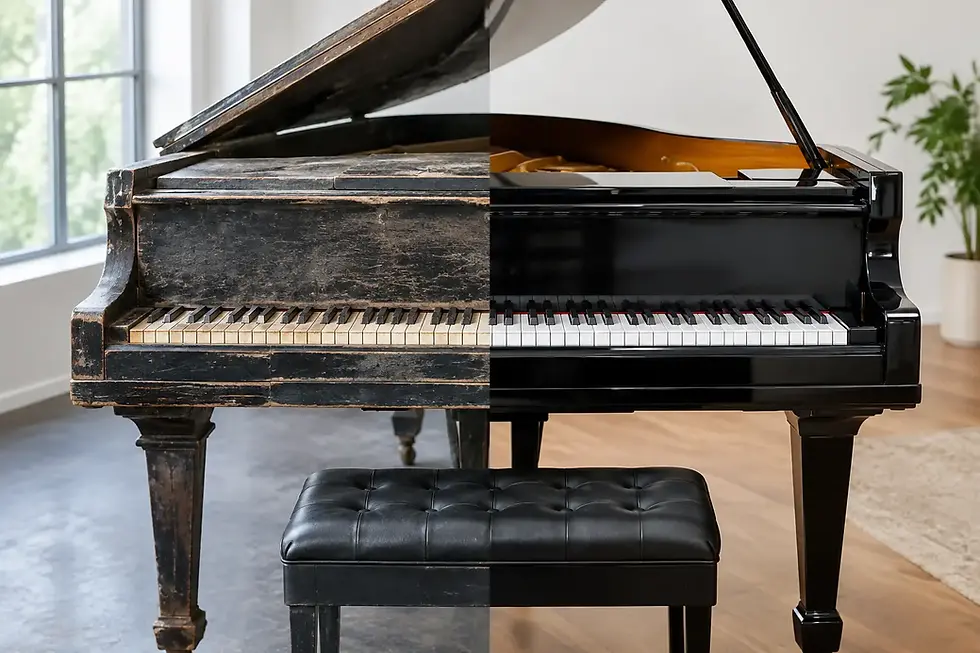
It is never embarrassing to ask for help with a piano that has been left untouched for a long time. Many inherited instruments, family pianos and second-hand purchases have simply fallen out of a maintenance routine. The useful question is not whether the piano is currently perfect, but what condition it is in and what can sensibly be improved.
Some neglected instruments respond very well to careful servicing and return to rewarding use. Others may have structural, pinblock, string, action or soundboard issues that limit how stable a tuning can be. A thorough assessment gives an honest picture, with clear advice on the work that is worthwhile and the likely musical outcome.
For owners across Woking, Guildford, Godalming and the surrounding area, a regular relationship with a trusted piano specialist offers particular reassurance. The same technician comes to understand the instrument, its home and the way it is played. That continuity is valuable, whether the piano supports a child’s first lessons or a serious musician’s daily practice.
A piano is at its best when it invites someone to sit down and play without hesitation. Keeping it in tune is a quiet but significant part of making that possible.

Comments