


When Does Piano Tuning in Surrey Matter Most?
A piano can look perfectly at home in a drawing room, school hall or teaching studio while quietly drifting away from its best sound. Piano tuning in Surrey is not simply about correcting a few notes that seem out of place. It is careful work that restores the musical relationships across all 88 keys, helps the instrument respond as it should, and gives an experienced technician the chance to spot developing concerns before they become more serious.
For a family piano used for lessons, that means children are learning with a dependable sense of pitch. For an accomplished player, it means voicing, pedalling and touch can be judged against a stable musical foundation. For a venue or school, it means the instrument is ready to support rehearsals and performances with confidence.
Why pianos gradually fall out of tune
Every piano is under considerable tension. Its strings pull against the frame and structure with great force, while the wooden soundboard, wrestplank, action parts and casework respond to their surroundings over time. Changes in temperature and, more significantly, humidity cause timber and felt to expand and contract. Those small movements alter string tension and affect pitch.
This is why a piano can go out of tune even when nobody has played it for several weeks. A centrally heated home that becomes very dry in winter, a conservatory that warms sharply during the day, or a room with fluctuating conditions can all make the tuning less stable. A piano placed against an outside wall or close to a radiator may be more exposed to these changes.
Regular playing also has an effect. Firm playing, repeated use of particular registers, and energetic practice can cause strings to settle incrementally. This is normal rather than a sign of poor quality. It does, however, explain why a well-used instrument benefits from regular expert attention.
How often should a piano be tuned?
For most privately owned pianos, tuning twice a year is a sensible standard. This gives the piano the best chance of remaining close to concert pitch and allows seasonal changes to be managed before they become pronounced. A piano that is used lightly in a stable room may sometimes cope with an annual visit, but the decision should be based on the instrument's condition, not merely how often it is played.
More frequent care can be appropriate for pianos in schools, teaching rooms, churches, hotels and performance spaces. These instruments often receive heavier use, encounter a wider range of room conditions, and need to be dependable for more than one player. A piano preparing for an examination, recital, recording session or special event should also be assessed in good time rather than left until the day before.
Newer pianos, and instruments that have recently moved house or undergone major restoration, may need additional tunings while their strings and structure settle. Equally, a piano that has been neglected for several years will not always return to stable pitch in one visit. Raising pitch too aggressively can place unnecessary strain on strings and structure, so a staged approach is often the more responsible course.
Tuning is not the same as repair
A common misunderstanding is that a tuning appointment will resolve every issue a player notices. Tuning addresses the pitch of the strings and the musical relationship between notes. It does not automatically correct a sticking key, a noisy pedal, uneven touch, sluggish repetition or a worn hammer surface.
Those concerns may call for regulation, repair or voicing. Regulation adjusts the action so that keys and hammers work evenly and predictably. Voicing refines the tonal character of the hammers, helping a piano sound less harsh, more even, or better balanced from bass to treble. The right work depends on what the instrument is doing and how it is being used.
A thoughtful technician will distinguish clearly between what is essential for reliable operation, what will improve musical performance, and what can reasonably be monitored for a later visit. That clarity matters, particularly where a cherished older piano has both sentimental value and practical limitations.
What expert piano tuning in Surrey involves
A proper tuning begins before the first string is adjusted. The technician should take time to listen to the piano, check its general condition and identify anything that may affect the work. Loose pins, damaged strings, seasonal instability, action faults and excessive dust or moth damage can all influence the outcome.
The tuning itself is a process of setting a stable temperament and carefully tuning unisons, where two or three strings are intended to sound as one note. It demands acute listening, controlled use of the tuning lever, and an understanding of how the piano will settle after each adjustment. A note may appear correct for a moment but prove unstable if the string has not been set securely.
On an upright piano, access and the relationship between its compact action and strings bring their own considerations. On a grand piano, the longer strings, more responsive action and broader tonal range often reveal small inconsistencies more readily. Neither type is inherently straightforward or difficult in every case. Condition, design, history and environment are more useful guides than size alone.
An expert visit should also include practical observations. If the piano is struggling to hold pitch because it is positioned beside a heat source, that should be explained. If several notes are beginning to stick, or if the pedals have developed unwanted noise, it is useful to know before a busy term of lessons or a planned gathering at home. Good piano care is as much about judgement as adjustment.
Signs your piano should not wait
Some pianos are clearly asking for attention. If octave intervals sound unsettled, familiar pieces feel uncomfortable to play, or chords have a wavering quality, tuning is likely overdue. Other signs are less obvious: a single note that will not blend with its neighbours, a persistent metallic buzz, a key that is slower than the rest, or a pedal that squeaks or fails to release cleanly.
After a house move, it is wise to allow a piano time to acclimatise before booking its tuning. The length of time depends on the season, the journey and the difference between the old and new rooms, but a few weeks is often sensible. Tuning immediately after a move can be disappointing if the instrument is still responding to new temperature and humidity levels.
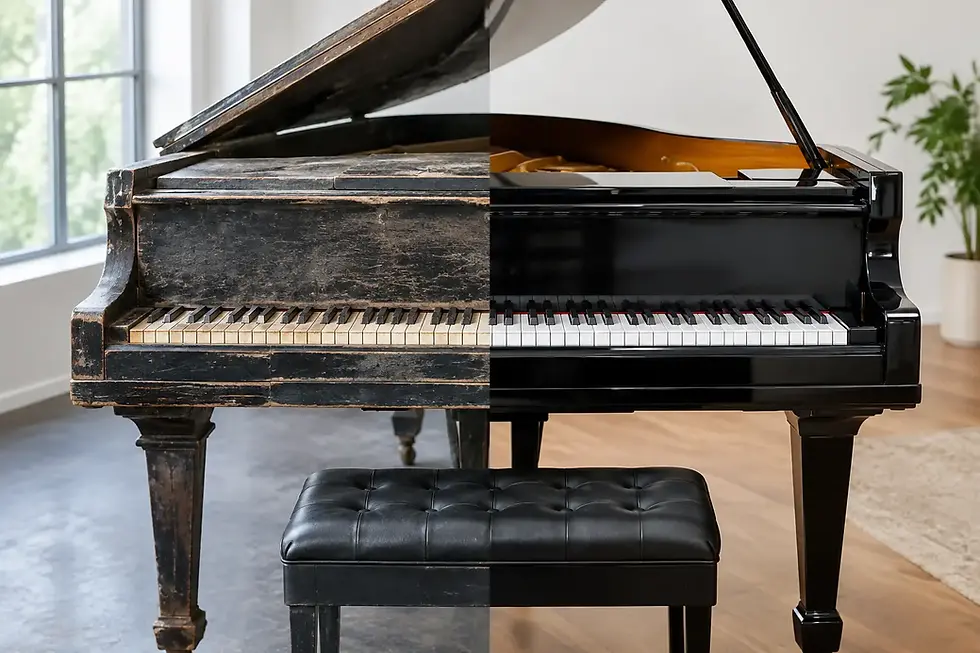
Do not assume that an old piano is beyond worthwhile care simply because it has missed several appointments. Some older instruments respond very well to sympathetic servicing; others have structural or tuning-pin limitations that need a frank assessment. The right answer is individual, and an honest inspection is more valuable than a promise that every piano can be made to perform like a new concert instrument.
Helping a piano stay stable between visits
The most useful thing an owner can do is provide a reasonably consistent environment. Keep the piano away from direct heat, strong sunlight, open fireplaces and persistently damp areas. Avoid placing drinks, vases or plant pots on the case, where spills can find their way into the action or onto the soundboard.
For homes with pronounced seasonal dryness or dampness, a room humidifier or dehumidifier may help, provided it is used sensibly and consistently. Sudden corrections can be as unhelpful as the conditions they are intended to solve. A simple hygrometer gives a clearer picture of what is happening in the room than guesswork alone.
Dust the exterior gently with a soft cloth, but avoid household sprays, polish near the keys, or attempting internal repairs. Piano actions contain many closely adjusted components, and a small well-meant intervention can create a larger issue. If a key sticks or a note begins to misbehave, make a note of when it happens and whether it is affected by weather or use. That information can be genuinely helpful during a service visit.
For owners in Woking, Guildford, Godalming, Staines and Egham, regular specialist care offers a practical way to protect an instrument that may be part of daily family life, serious study or professional work. Runnymede Pianos approaches each visit with the same aim: to leave the piano sounding more settled, feeling more dependable and understood more clearly by its owner.
A piano rewards attention over time. Kept in a stable room and heard regularly by a skilled technician, it remains not just a piece of furniture with keys, but a responsive musical instrument ready when someone sits down to play.


Comments