


A Complete Guide to Buying Pianos for Your Home
A piano can become the musical centre of a home for decades, but it is not an appliance to choose from a photograph. The complete guide to buying pianos begins with a simple principle: the right instrument must suit the player, the room and the life it will lead. A piano that feels inspiring to play and receives proper care will reward a family far beyond the first few lessons.
Begin with the player, not the piano
Before considering makes, finishes or cabinet styles, think carefully about who will play. A young beginner needs a reliable instrument with an even, responsive touch that encourages good technique. An advancing student may need greater tonal range, repetition and control. An accomplished pianist will often notice finer distinctions in voicing, dynamic range and the way an action responds under the fingers.
It is tempting to select the smallest piano that will fit the available space. Yet a piano should not merely occupy a corner. It should invite regular playing. Consider how often it will be used, whether lessons will take place at home, and whether the household enjoys music-making beyond formal practice. A well-chosen acoustic piano often becomes part of family life in a way few other possessions do.
Upright or grand piano?
For most homes, an upright piano is the practical and musically satisfying choice. A good upright offers a substantial sound, a full keyboard and a properly weighted action without requiring the floor space of a grand. Taller uprights generally allow for longer strings and a larger soundboard, which can contribute to a richer, more resonant tone. This is not a rule without exception, however. Condition, design and preparation matter as much as dimensions.
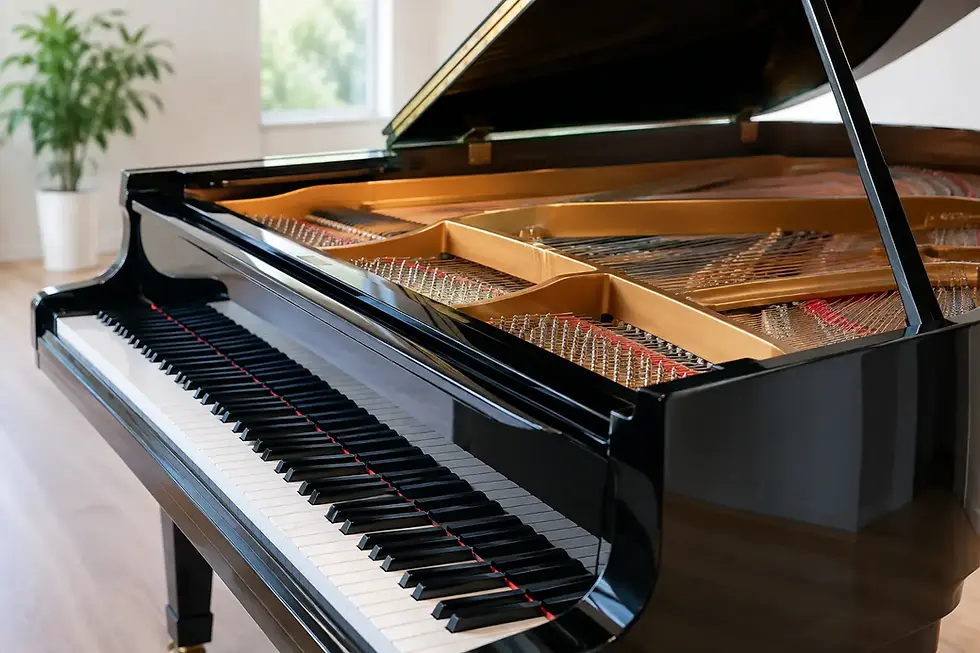
A grand piano offers a different playing experience. Its horizontal string layout and action can provide greater tonal breadth, subtle control and repetition, particularly for advanced repertoire. It also requires a room that can accommodate its footprint, lid opening and sound without overwhelming conversation or neighbouring rooms.
The question is not simply whether a grand is better. It is whether it is right for the setting. In a modest room, a carefully selected upright can be more balanced, more comfortable to live with and more musically useful than a larger instrument placed without sufficient space around it.
Let the room guide the decision
Measure the intended position, including access routes. A piano needs to pass through doors, halls, turns and staircases before it can be enjoyed in the sitting room or studio. It should stand away from direct sunlight, radiators, fires, exterior doors and areas prone to damp. Sudden changes in temperature and humidity place strain on timber, glue joints, the soundboard and tuning stability.
Acoustics matter too. Hard floors and bare walls can make a lively piano seem overly bright, while heavy furnishings may soften its sound. A rug, curtains and bookshelves can make a meaningful difference. The aim is not silence but a room in which the piano sounds clear, warm and comfortable at the volume it naturally produces.
What to listen and feel for when trying a piano
Never judge an acoustic piano solely by its appearance. Sit down and play it, even if your own playing is limited. Ask a teacher or experienced pianist to accompany you if possible. A good piano should speak readily across the keyboard, from bass to treble, without abrupt changes in volume or character.
Listen for a tone that you genuinely enjoy. Some players prefer warmth and depth; others favour a brighter, more immediate sound. Neither preference is inherently superior. What matters is that the sound has colour and that it can be shaped, becoming gentle when played quietly and more expansive when played with energy.
The touch should feel even from note to note. Keys should return promptly, sit at a consistent height and not feel loose, noisy or reluctant. Play repeated notes, simple scales and chords at different strengths. Notice whether the piano gives you a sense of connection and control rather than making every note feel like hard work.
Pedals deserve attention as well. The sustaining pedal should operate smoothly and release cleanly. On an upright, the soft pedal and practice mechanism, where fitted, should work quietly and correctly. Small irregularities can sometimes be adjusted during servicing; widespread inconsistency is a sign that the instrument needs closer assessment.
A complete guide to buying pianos includes condition
With a pre-owned piano, age alone tells very little. A well-made instrument that has been maintained in a stable environment can remain a fine musical partner for many years. Conversely, a piano that has endured damp, excessive heat, neglect or prolonged instability may carry problems not immediately visible from the casework.
The soundboard, bridges, strings, tuning pins, action and internal structure all deserve inspection. Fine surface marks on a cabinet may be cosmetic. Structural cracks, loose tuning pins, corrosion, moth damage in felt components or uneven action wear are more significant. A piano may be capable of sounding acceptable for a brief demonstration while still requiring substantial technical attention to become dependable.
This is why an independent assessment by a qualified piano technician is so valuable. It provides a clearer understanding of the instrument's musical potential, its present condition and the work required for reliable ownership. It also protects the buyer from mistaking a recently polished cabinet for a genuinely sound piano.
Refurbished pianos and what preparation means
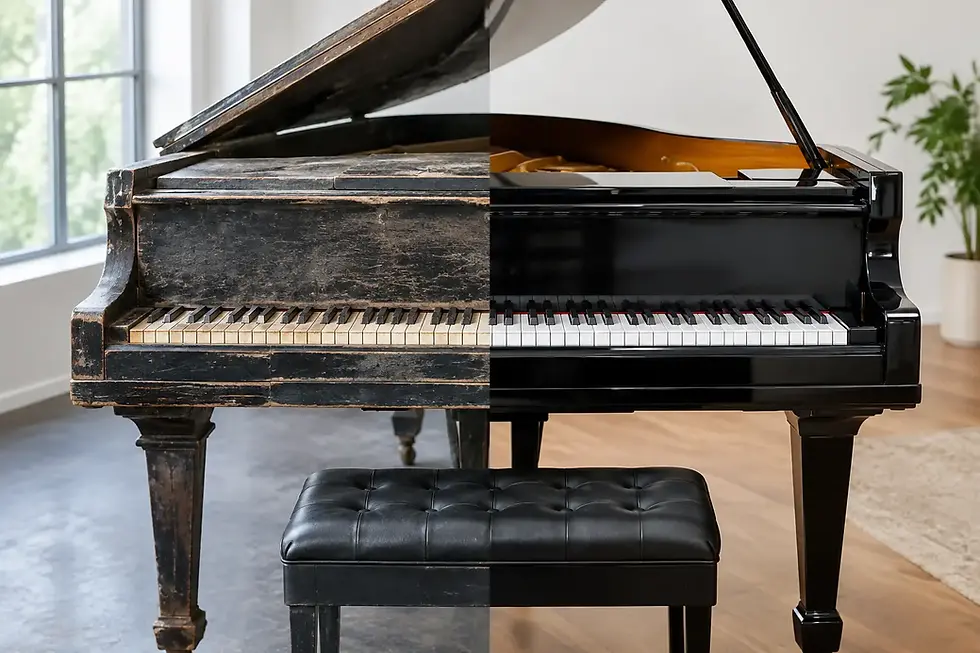
The word refurbished can cover very different standards of work. At its best, refurbishment is a careful programme of technical and cosmetic preparation, carried out with respect for the instrument's original character. It may include action regulation, voicing, tuning, replacement of worn components, casework attention and thorough cleaning.
The essential question is not whether a piano is described as refurbished, but what has actually been done and by whom. Ask for a clear explanation of the preparation. A reputable specialist will be straightforward about the piano's history, current condition and the level of work completed. Careful selection and honest presentation are part of a commitment to quality and value.
Do not overlook the action and regulation
A piano action contains thousands of moving parts. It translates the movement of a key into the striking of a hammer against a string, often many times during a single piece of music. When properly regulated, it feels responsive, predictable and expressive. When poorly regulated, it can be uneven, tiring or frustrating, particularly for a learner trying to develop sound technique.
Regulation is not a one-off improvement. Felt and timber settle with use, and seasonal changes affect the instrument. A piano should therefore be viewed as something that benefits from ongoing expert care, not a finished object that can be left untouched after delivery.
Tuning is similarly essential, but it is only one element of musical health. A piano can be in tune and still have a harsh tone, sticking notes or an irregular touch. A proper maintenance relationship addresses the whole instrument, allowing problems to be identified before they become more disruptive.
Consider a digital piano with clear eyes
A digital piano can be an excellent solution where silent practice, portability or restricted space is the priority. Headphones, recording functions and adjustable volume may suit busy households, flats or late-evening practice. The best models offer weighted keys and a credible musical response, but they remain a different experience from an acoustic piano.
An acoustic piano creates sound through strings, hammers and a resonating soundboard. Its touch and tone respond to the player in organic, variable ways. For many students, that physical feedback is central to musical development. The right choice depends on circumstances, but it is wise to understand the distinction rather than assume the two instruments are interchangeable.
Plan for delivery and care from the outset
Professional piano delivery is essential. Pianos are heavy, finely balanced instruments with delicate internal mechanisms. They need appropriate equipment, experienced handlers and careful positioning once inside the property. After a move, allow the instrument to settle into its new environment before arranging tuning.
A piano usually benefits from regular tuning, commonly at least twice a year, depending on use and environmental stability. Keep the room reasonably consistent, avoid placing drinks or objects on the case, and close the lid when the instrument is not in use. These small habits help protect both the finish and the mechanism.
For buyers in Surrey and the surrounding South East, Runnymede Pianos can offer the personal advantage of specialist guidance from selection through to long-term care. The value lies in choosing with confidence, knowing the instrument has been considered as a musical whole rather than simply as furniture.
The finest first step is to play several pianos without rushing the decision. Give your ears and hands time to notice the difference. The piano that continues to draw you back to the stool is often the one with which a lasting musical relationship begins.

Comments