


Help Finding the Right Piano
A piano can look perfect in a photograph and still be entirely wrong once your hands meet the keys. That is why many people ask for help finding the right piano only after they have already seen too many instruments, heard too many opinions, and realised that this is not a purchase to make on guesswork.
The right piano is not simply the one with the most attractive cabinet, the brightest tone, or the most familiar name. It is the one that suits the player, the room, and the purpose it needs to serve over many years. For a family starting lessons, that may mean a dependable instrument with a balanced touch and stable tuning. For a more advanced pianist, it may mean a piano with greater colour, control, and scope. For a school or venue, reliability and consistency may matter just as much as musical character.
What help finding the right piano should actually involve
Good piano advice starts with listening before it starts with selling. A specialist should want to know who will play the instrument, how often it will be used, what sort of room it will live in, and what standard of touch and tone is expected. Without those details, recommendations are little more than educated guesses.
This matters because pianos are deeply individual. Two instruments of similar size and age can feel markedly different under the fingers. One may have a clear, singing treble and a responsive action that encourages careful playing. Another may sound louder at first hearing yet offer less control and less satisfaction over time. The difference is not always obvious to a first-time buyer, which is exactly where expert guidance proves its value.
Begin with the player, not the piano
The most reliable starting point is the player’s present and future needs. A beginner does not need a concert instrument, but they do need a piano that makes good habits easier to learn. If the action is uneven or heavy in the wrong way, technique suffers. If the tone is harsh, practice becomes less inviting. Children especially respond to the feel and sound of an instrument more than adults often expect.
For progressing students, the piano should leave room for development. It should allow dynamic control, repetition, and a range of tone colours rather than simply producing notes. An advanced player will usually notice these things quickly, but families buying for a child with growing commitment may not yet know what to look for. In such cases, choosing with the next several years in mind is often wiser than choosing only for the present moment.
For experienced pianists, the question becomes more refined. Is the priority warmth, clarity, depth of bass, or delicacy in the middle register? Is the action crisp and articulate, or more forgiving and rounded? There is no universally correct answer. There is only suitability.
Upright or grand?
This is often treated as the first question, though in practice it is only one part of a larger decision. A well-prepared upright can be a splendid musical tool and, in many homes, the more sensible choice. It takes less space, often sits more comfortably within domestic rooms, and can offer excellent control when properly regulated and voiced.
A grand piano brings different advantages. Its action design allows more subtle repetition and can offer a greater sense of openness and tonal bloom. That said, a grand is not automatically better simply because it is a grand. A modest grand in poor condition may be far less satisfying than a carefully selected upright that has been properly restored and prepared.
The room should also guide the choice. A piano must suit the acoustic space around it. In a smaller room with hard surfaces, an overly powerful instrument can become tiring to play and difficult to live with. In a larger space, a smaller or thinner-sounding piano may struggle to give a pleasing result.
Condition matters more than appearance
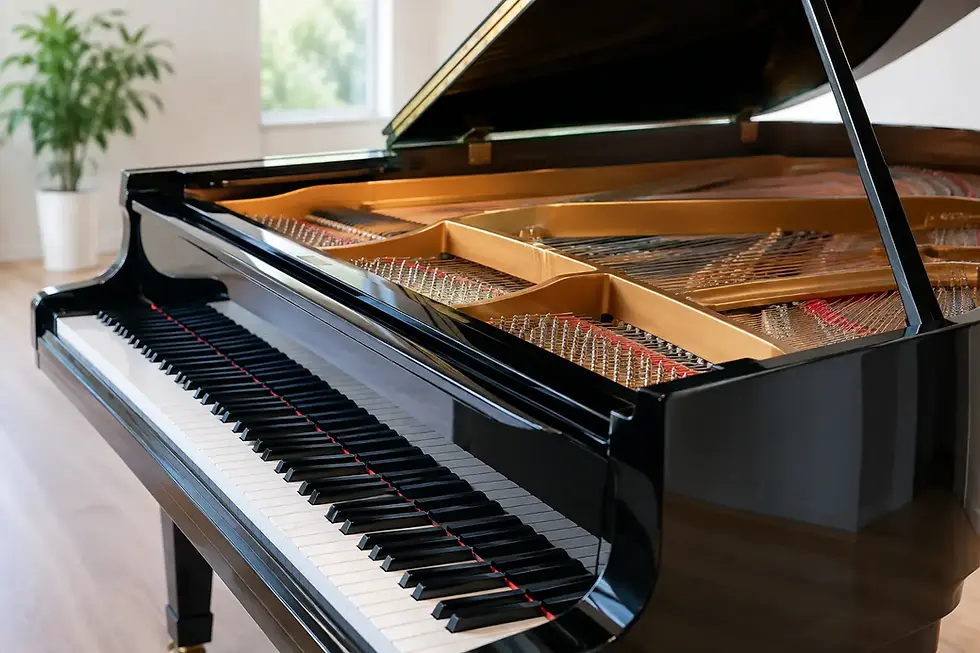
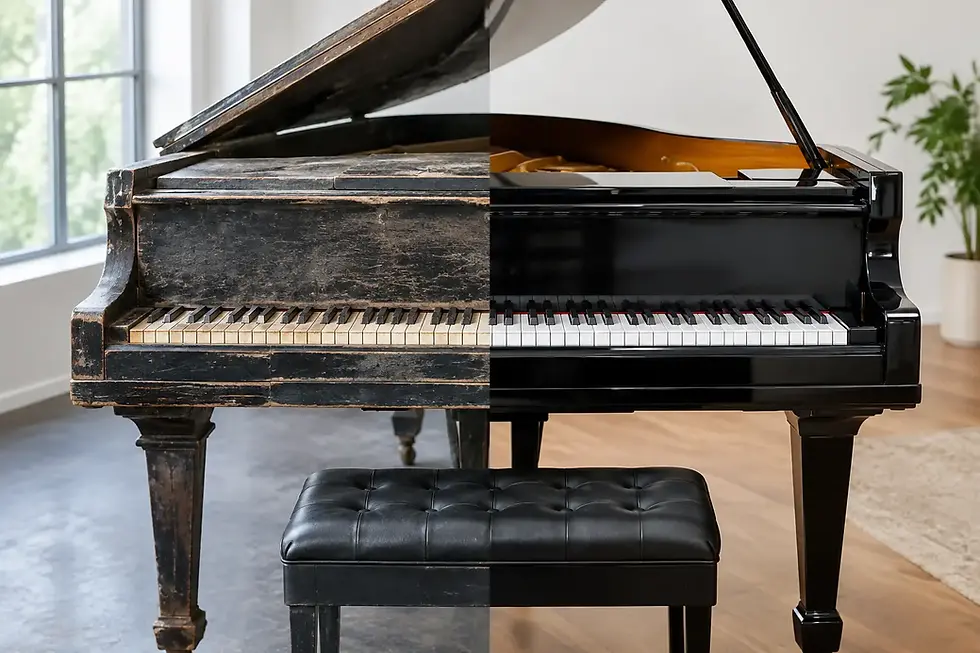
One of the most common mistakes buyers make is assuming that polish and presentation tell the real story. Cabinet condition has its place, of course, but the musical and mechanical condition of a piano is what determines whether it will be rewarding to own.
A specialist inspection should look closely at the action, wrest plank stability, bridges, soundboard, strings, tuning pins, dampers, pedal function, key level, hammer wear, and general regulation. These points are not minor details. They affect touch, tone, tuning stability, and the long-term reliability of the instrument.
This is where private sales and casual marketplace listings can be risky. A piano may be described as "lovely" or "in good condition" by a well-meaning seller, yet still have significant issues that a non-specialist would neither recognise nor disclose. That does not mean every older piano should be avoided. Many mature instruments are deeply rewarding. It simply means that age alone is neither a virtue nor a fault. Preparation and condition are what count.
Tone and touch are not luxuries
When people seek help finding the right piano, they sometimes assume that tone and touch are concerns only for professionals. In reality, they matter at every level. A beginner benefits from an action that responds predictably and evenly. A parent listening from the next room benefits from a tone that is pleasant rather than brittle. A teacher benefits from a piano that supports rather than hinders musical progress.
Tone is partly personal taste, but only partly. A piano should be capable of warmth without muddiness, brightness without aggression, and clarity across the compass. Touch should feel even from note to note, allowing control from soft playing through to full tone. If the keys vary noticeably in weight or response, the player ends up adapting to the piano instead of learning from it.
This is why trying an instrument properly matters. Not just a few scales and chords, but soft playing, repeated notes, pedalled passages, and changes of character. A piano reveals itself gradually.
The room and the environment
Pianos are sensitive to their surroundings. Central heating, underfloor heating, direct sunlight, draughts, and fluctuating humidity all affect how an instrument performs and ages. A good choice on paper can become a poor choice if it is placed in the wrong environment.
Sometimes the right piano is not the largest one that fits through the door, but the one best suited to the conditions of the house. A specialist should ask where the piano will stand and whether the room is stable enough to support it well. This is particularly relevant in period properties, open-plan spaces, and rooms with large windows.
In homes across Surrey, London and the wider South East, these practical details are often more important than buyers first realise. Expert advice is not only about selecting a fine instrument. It is about placing the right instrument in the right setting so it continues to perform as it should.
Why curated selection is better than endless browsing
Too much choice can make the process harder, not easier. When every instrument is presented as exceptional, buyers are left comparing surfaces rather than substance. A curated approach is far more useful. It narrows the field to pianos that have already been assessed for musical quality, condition, and suitability.
That does not remove personal choice. On the contrary, it sharpens it. Instead of spending weeks sorting through unsuitable options, you can focus on the meaningful differences between genuinely worthwhile instruments. That usually leads to a calmer, more confident decision.
For this reason, specialist businesses such as Runnymede Pianos take a more considered approach than a volume retailer. The aim is not simply to move stock. It is to match an instrument carefully to the owner, with proper regard for touch, tone, reliability and long-term satisfaction.
Help finding the right piano for different settings
A family home needs an instrument that invites regular practice and stands up well to everyday use. A teaching studio needs consistency across long hours and different players. A venue may need an instrument that speaks well in the room and remains dependable under demanding use. These are not the same brief, even if the piano itself appears similar at first glance.
That is why bespoke advice matters. The best recommendation for a young learner in a sitting room is not necessarily the best recommendation for a diploma student, and neither may suit a restaurant, school hall, or rehearsal space. The right answer changes with context.
If you are uncertain, that is not a sign that you are unprepared. It is simply a sign that pianos are more complex than most people are led to believe. A good specialist should make that complexity manageable without making the process feel intimidating.
The best piano purchase rarely begins with chasing the most impressive option. It begins with a careful conversation, an honest assessment of needs, and the patience to choose an instrument that will still feel right long after the first impression has faded.

Comments