

How to Choose Piano Rental Well
- Toby Johnson
- Jul 6
- 6 min read
A piano rented in haste often reveals its shortcomings within a fortnight. The touch feels heavy for a child, the tone is thin in the middle register, or the cabinet simply overpowers the room. If you are wondering how to choose piano rental sensibly, the best approach is to think less like a bargain hunter and more like a custodian choosing an instrument for a specific musical purpose.
A good rental piano should make practice inviting, not discouraging. It should suit the player’s level, the room it will live in, and the length of time you expect to need it. That sounds straightforward, but the right choice depends on details that are easy to miss if you focus only on appearance or convenience.
How to choose piano rental for your situation
The first question is not which piano looks best, but why you are renting at all. A family may want a serious instrument for a child who has progressed beyond the limitations of a digital keyboard. A school may need a dependable upright that can withstand daily use. A venue may require an instrument that presents well and responds consistently for performance.
Those are three very different briefs. A beginner at home usually benefits from a stable, musically satisfying upright with an even action and a clear tone. A more advanced pianist may be sensitive to repetition speed, key weighting and tonal control. For a hospitality setting or event space, appearance, reliability and tuning stability may matter as much as tonal subtlety.
This is why specialist guidance matters. A proper rental should not be treated as a generic household item. It is a mechanical and musical instrument, and its value lies in how it behaves under the fingers over time.
Start with the player, not the piano
When families choose a piano, they sometimes ask for the smallest instrument that will fit the room. That is understandable, but size alone is not the best starting point. Begin with the player’s needs.
For a young student, the key issue is whether the instrument encourages good habits. If the action is inconsistent, too stiff or poorly regulated, it can interfere with technique from the outset. Children do not always have the language to explain this. They simply practise less, or play with tension. An upright with a responsive action and a pleasant, singing tone is often the wiser choice than a more compact instrument that feels compromised.
For an intermediate or advanced pianist, the standard rises. At that level, a rental piano should offer enough tonal range and control to support proper musical development. Pedalling, voicing and articulation all become more exposed. An instrument that is merely acceptable for elementary work may become frustrating very quickly.
If several people in the household will use the piano, aim for the best overall playing experience rather than an instrument chosen around one narrow requirement. The piano should serve the musical life of the home, not just occupy a corner neatly.
Consider the room honestly
A piano does not sound the same in every setting. Hard floors, large windows and sparse furnishings can make a bright piano seem sharper than expected. A carpeted room with heavy curtains may soften the sound considerably. Ceiling height also matters more than many people realise.
This affects both tone and practicality. A taller upright often gives a fuller, richer sound, but in a very compact room that same instrument may feel visually and sonically dominant. On the other hand, choosing too small a piano for a generous room can leave the sound undernourished.
There is also the matter of placement. A piano should not be pushed up against a radiator or left in direct sunlight. Stable environmental conditions help preserve tuning and regulation. If your available space is limited to a wall with heating pipes or strong afternoon sun, that should be discussed before the instrument is selected, not after it is delivered.
Condition matters more than age
One of the most common misunderstandings in piano rental is the assumption that a newer piano is automatically the better one. In practice, condition and preparation matter far more than date alone.
A well-maintained instrument that has been properly serviced can be a far better musical companion than a newer piano that has had indifferent preparation. What you want from a rental is consistency. The keys should move evenly, the pedals should work quietly and predictably, and the tone should be balanced across the compass rather than pleasant in one register and weak in another.
Ask how the instrument has been prepared before rental. A specialist provider should be able to explain its condition with confidence. Tuning is only part of the picture. Regulation, minor repairs and general musical set-up all contribute to whether a piano feels satisfying to play.
The cabinet should also be in respectable order, particularly if the piano will sit in a reception room, studio or venue. Cosmetic condition is not merely about appearances. It often reflects the general standard of care the instrument has received.
Upright or grand - choose by use, not prestige
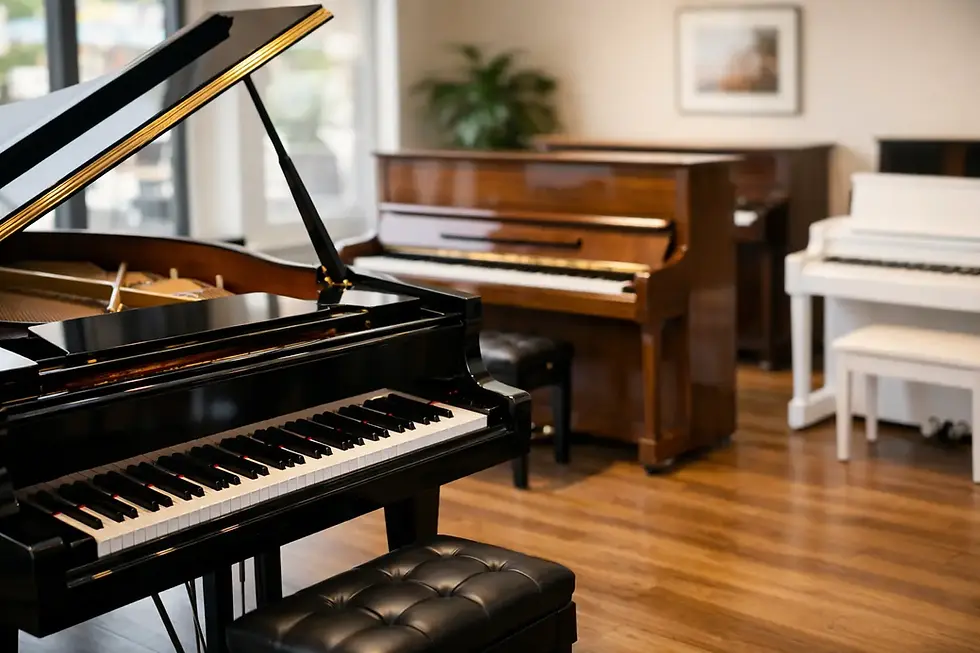
For most domestic rentals, an upright piano is the practical and sensible choice. A good upright offers excellent musical value, occupies less space and is easier to place in a typical home. For students, teachers and many families, it is entirely sufficient.
A grand piano becomes appropriate when the musical setting truly calls for it - advanced repertoire, performance use, recording, or a room where its tonal and visual presence can be appreciated properly. Renting a grand simply because it feels more impressive can create avoidable complications. It needs the right space, the right floor plan and, ideally, a player able to benefit from what it offers.
There is no hierarchy of virtue in this. The better question is whether the instrument fits the purpose. A carefully selected upright often serves more successfully than a grand chosen for the wrong reasons.
How to judge touch and tone when you try one
If you have the chance to play the piano before agreeing to a rental, keep your assessment simple and attentive. You do not need to be a concert pianist to recognise whether an instrument feels cooperative.
Play slowly first. Notice whether some keys feel heavier or less responsive than others. Listen for notes that stand out too much or disappear too quickly. Test soft playing as well as fuller dynamics. A piano that only sounds attractive when played firmly may be less rewarding for daily study.
Then pay attention to repetition. Can you play the same note several times without the mechanism feeling sluggish? Does the keyboard feel even from bass to treble? If you use the pedals, do they function cleanly without noise or uncertainty?
A teacher can be very helpful at this stage, particularly for parents choosing a first acoustic piano. Even a brief outside opinion may save months of frustration.
Look carefully at the rental terms
A fine instrument can still be the wrong rental if the practical arrangements are vague. Clarity matters. You should understand what is included in the agreement, how the piano will be delivered, and what happens if the instrument proves unsuitable for the space or musical requirement.
It is also sensible to ask about tuning and maintenance responsibility during the rental period. Pianos require care, and a professional provider should set out expectations clearly. A trustworthy arrangement feels transparent from the start.
This is where dealing with a specialist rather than a volume-led supplier has real value. You are not merely hiring an object. You are relying on somebody’s judgement about an instrument that affects practice, teaching and enjoyment every day.
The importance of expert matching
The strongest rental experiences usually come from careful matching rather than broad stock lists. A provider with technical knowledge and musical understanding can often identify the right instrument quickly by asking the right questions: who will play it, how often, in what room, and to what standard.
That level of attention tends to produce better outcomes than a purely transactional approach. It also gives you confidence that the instrument has been chosen with purpose. For families, schools and serious players alike, that reassurance is worth a great deal because it reduces uncertainty at a point where many people feel out of their depth.
In areas such as Surrey and London, where homes, studios and venues vary widely in space and acoustic character, this sort of bespoke advice is especially valuable. No two settings are quite the same, and no worthwhile piano rental decision should pretend otherwise.
Choosing well means respecting the instrument and the person who will play it. If the piano feels right under the fingers, sits comfortably in the room and has been prepared with care, practice tends to follow naturally - and that is usually the clearest sign that the decision was a sound one.


Comments