

Is a Bechstein Piano Right for Your Home?
A Bechstein piano is often recognised before a note is played. The name carries a serious musical heritage, but the right instrument is never chosen by reputation alone. Whether you are looking for a piano for a discerning young player, a period home, a teaching studio or your own return to regular playing, its individual condition, character and suitability for the room deserve careful attention.
Bechstein instruments can offer an unusually satisfying combination of colour, clarity and refinement. They can also vary considerably, particularly across different eras and after decades of use. Understanding what to listen and look for will help you choose with confidence rather than simply buying a distinguished name on the fallboard.
What sets a Bechstein piano apart?
C. Bechstein was founded in Berlin in the nineteenth century and became closely associated with concert life, composers and leading European pianists. That history matters because the firm developed pianos for demanding musical settings, where responsiveness, projection and a wide palette of tone were essential.
A well-prepared Bechstein commonly has a singing treble, a clear middle register and a bass that supports rather than overwhelms the rest of the instrument. The sound can be complex and expressive, with enough transparency for classical repertoire while retaining warmth for romantic music, jazz and more intimate playing. It is not simply a matter of volume. The appeal is often in the range of tonal shading available under the fingers.
The action is equally significant. A good Bechstein should allow the player to control very quiet notes without effort, then build to a full sound without harshness. This sense of connection between finger and sound is one reason experienced players are drawn to the marque. Yet no two examples feel identical. Design changes, maintenance history, regulation and the condition of the action materials all influence the result.
The Bechstein piano sound: character over labels
It is tempting to describe any make in a few fixed words, but pianos do not work that way. A compact upright in a family sitting room cannot be expected to produce the same scale or depth as a larger grand, even when both bear the same name. Likewise, a piano voiced for a bright, projecting room may feel too forceful in a heavily furnished home.
A Bechstein is often chosen by players who value detail in the tone. Listen for the way a melody carries above accompanying chords, how clearly repeated notes speak and whether the sound remains even as you move from bass to treble. Play softly as well as loudly. A piano that impresses only at full volume may be less rewarding for daily practice than one that responds beautifully at moderate dynamics.
For a home, the most suitable tonal character depends on the room and the player. A lively room with wooden floors, large windows and little soft furnishing may favour a more rounded voice. In a carpeted room with books and upholstery, a little extra brilliance may be welcome. Thoughtful voicing can make a meaningful difference, but it cannot turn an unsuitable instrument into the right one. Selecting well at the outset remains the better course.
Older instruments require informed assessment
Many people encounter Bechstein pianos through inherited instruments or refurbished examples. Some older models are superb musical pianos with exceptional craftsmanship and mature tonal character. Others need substantial work before they can offer dependable service. Age alone is neither a recommendation nor a reason to dismiss a piano.
The soundboard, bridges, pinblock, strings, action, pedals and cabinet should all be considered as part of one whole. Cosmetic presentation can be attractive while mechanical wear remains hidden beneath the keys. Conversely, a piano with modest cabinet marks may have a sound structure and an excellent action after conscientious restoration.
A proper assessment asks practical questions. Does the piano hold its tuning securely? Are there buzzing strings, cracks affecting the bridges, uneven notes or sluggish repetition? Is the touch consistent across the keyboard? Have the hammers become deeply grooved or excessively hardened? Are the dampers lifting and settling cleanly? These details affect both musical pleasure and long-term reliability.
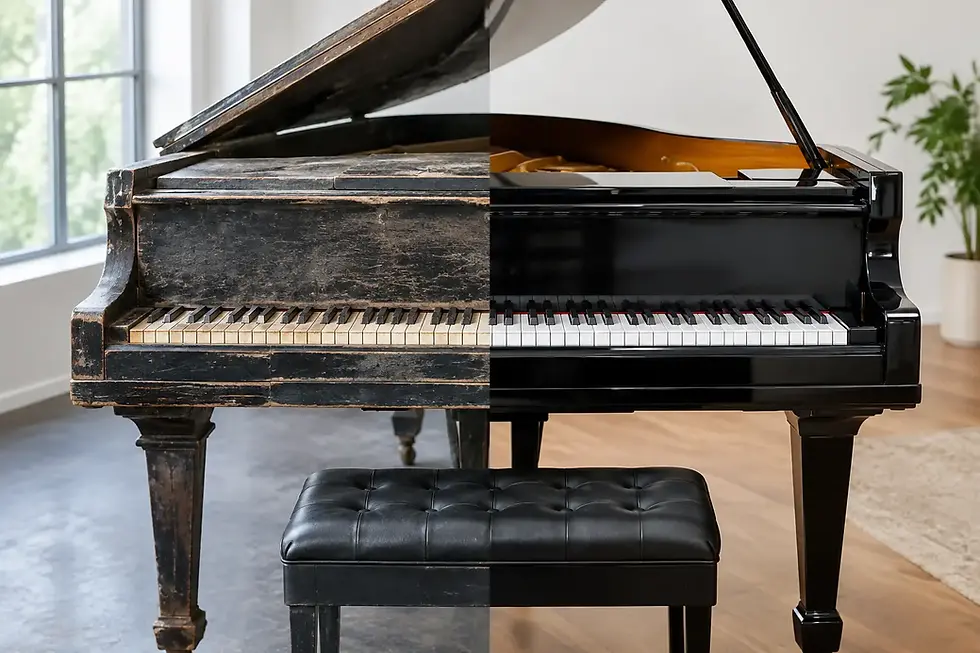
There is also an important distinction between a piano that has been cleaned up and one that has been properly restored. Restoration should be led by the needs of the specific instrument, not by a wish to make every piano look new. Preserving worthwhile original character, while renewing worn components where necessary, is often the most respectful and musical approach.
Why regulation and voicing matter
Even a fine piano can feel disappointing when its action is poorly regulated. Regulation is the careful adjustment of the many moving parts between key and hammer so that the keyboard responds evenly and predictably. It governs aspects such as key depth, repetition, hammer let-off and damping.
Voicing concerns the quality of the sound itself. Through skilled work on the hammer felt, a technician can reduce excessive harshness, restore clarity or bring greater consistency from note to note. This is delicate work. Over-softening can leave a piano dull and lacking definition, while an over-bright tone can become tiring in a domestic room. The best result respects the instrument’s natural voice rather than imposing an artificial one.
Choosing the right size and model
The best Bechstein piano for a household is not automatically the largest one that will fit through the door. Space around the instrument, the acoustics of the room and the needs of the player all matter. An upright can be an excellent long-term choice where room is limited, provided it has sufficient scale, good action response and a properly maintained structure.
A grand piano offers a different mechanism and, in many cases, greater tonal reserve and control. It can be especially rewarding for advanced repertoire, frequent teaching or performance at home. However, it also asks more of the room. A grand placed too close to radiators, exterior doors or strong sunlight may be exposed to unnecessary changes in temperature and humidity. Its size should enhance the space, not dominate it.
When comparing instruments, allow time for repeated playing. Start with music you know well, then try slow chords, scales, repeated notes and very soft passages. Notice whether the piano invites you to stay at it. For a child beginning lessons, the instrument should be stable, in tune and pleasant enough to encourage practice. For an advanced player, the greater question may be whether its action and tonal range continue to offer room for artistic development.
Care that protects a fine instrument
Once chosen, a Bechstein deserves regular professional attention. Tuning is not merely about correcting notes that have drifted sharp or flat. It supports the piano’s overall stability and makes musical practice more satisfying. In homes with central heating, underfloor heating or significant seasonal changes, the piano’s environment should be monitored with particular care.
Keep the instrument away from radiators, fireplaces, conservatories and draughty external walls where possible. Avoid placing drinks, plants or ornaments on the cabinet, and close the lid when the piano is not in use, particularly in busy family homes. These are simple measures, but they protect finish, soundboard and action from avoidable harm.
Periodic servicing also gives a technician the chance to spot early signs of moth damage, loose components, worn action centres or changes in tuning stability. Small interventions made at the right time are generally kinder to the instrument than allowing several issues to accumulate.
A piano to choose with patience
A Bechstein piano can become the musical centre of a home for many years, but it should be selected with ears, hands and informed judgement. The badge may lead you to an instrument; its tone, touch, structural health and preparation should decide whether it earns a place in your life.
For owners and buyers in Surrey and the surrounding area, Runnymede Pianos can provide the specialist assessment and careful preparation that such an instrument merits. The most rewarding choice is usually the one that feels musically alive from the first quiet phrase, and remains a pleasure to return to long after the novelty has passed.

Comments