


Refurbished Upright Piano for Sale Guide
A piano can look handsome in polished black and still be a poor musical investment. That is why anyone searching for a refurbished upright piano for sale should look beyond cabinet finish and price tag. The real value lies in the quality of the work, the stability of the instrument, and whether it offers a touch and tone that will still satisfy you years from now.
For families buying a first serious piano, for teachers upgrading from a tired practice instrument, and for experienced players who want a dependable upright without stepping into grand piano costs, refurbishment can make excellent sense. But the term is used rather loosely. One seller may mean a genuine programme of technical restoration and regulation. Another may mean little more than a clean, a polish, and a hopeful description.
What a refurbished upright piano for sale should actually mean
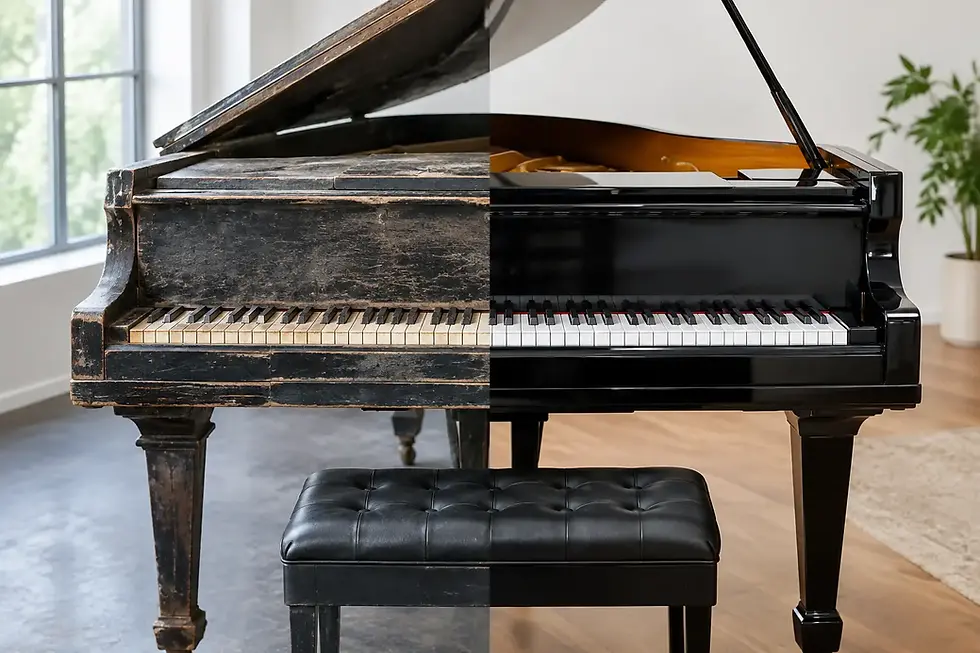
A properly refurbished upright piano has been assessed and improved where it matters most - structurally, mechanically, and musically. That may include repairs to the action, replacement of worn felts, regulation of the keyboard and action, easing of stiff centres, voicing of hammers, string work where needed, and careful tuning once the piano is stable enough to hold pitch well.
The best refurbishment is never cosmetic first. Cabinet work has its place, particularly if a piano is going into a principal room, school reception area, or venue. Yet appearance should follow function. If the wrest plank is failing, the action is uneven, or the bass is dull from severe wear, a polished case does not solve the underlying problem.
This is where expert judgment matters. Not every older upright deserves the same level of work, and not every buyer needs the same result. A family piano for daily lessons has different priorities from an instrument intended for Grade 8 practice or professional accompaniment. Good refurbishment aligns the instrument with its intended use.
Why buyers choose refurbished over new
A new upright can be an excellent purchase, but a well-refurbished piano often offers stronger value in the middle of the market. Many older pianos were built with high-quality materials and craftsmanship that remain attractive today. When these instruments are carefully restored and regulated, they can provide a mature tone, a pleasingly responsive action, and a more substantial musical character than some cheaper new alternatives.
There is also a practical advantage. A refurbished upright piano for sale has already shown how it behaves in real conditions over time. If it has been competently rebuilt, tuned, and prepared, there is less uncertainty than with a neglected second-hand instrument bought privately. The key distinction is between a curated, workshop-prepared piano and an unknown one simply described as "in good condition".
For many households, there is a sensible middle ground here. You avoid the risk of buying a worn-out piano from a marketplace advert, while also avoiding the expense of a brand-new premium upright. The result can be an instrument with genuine longevity and musical merit.
What to check before you buy
The first thing to assess is tuning stability. Ask whether the piano is currently at concert pitch and how consistently it holds. A piano that is substantially below pitch may need more than an ordinary tuning, and in some cases low pitch can point to larger structural concerns.
Touch is just as important. Play every note if you can. The keyboard should feel even, not heavy in one area and weak in another. Repetition should be reliable, and there should be no sticking keys, sluggish return, or obvious unevenness in volume. These faults are often repairable, but you should know whether they have already been addressed.
Listen for clarity across the compass. A good upright will not sound identical from bass to treble, nor should it. But it should feel coherent. If the middle register is thin, the treble harsh, or the bass lifeless, ask what work has been carried out on the hammers, strings, and action. Tone can often be improved, but only with proper preparation.
Then consider the cabinet and pedals. Cosmetic wear is not always a concern if the musical standard is high, especially in a teaching room or studio. On the other hand, loose pedals, missing parts, poor repairs, or signs of damp exposure deserve attention. A piano lives under tension, and neglect leaves clues.
Questions worth asking the seller
A serious seller should be comfortable discussing the instrument in plain terms. Ask what refurbishment has been completed and when. Ask whether any major components have been replaced, whether the action has been regulated, and whether the piano has been tuned several times after the work rather than simply once before sale.
It is also reasonable to ask who carried out the work. There is a significant difference between specialist piano refurbishment and general furniture restoration. One serves the instrument as a musical machine. The other may only improve appearance.
You should also ask about delivery, positioning, and aftercare. Upright pianos are sensitive to environment, and even a well-prepared instrument will need settling in after transport. A conscientious specialist will explain what to expect once the piano arrives, including when it should next be tuned.
The trade-off between age, price, and performance
There is no universal sweet spot. Some buyers assume newer is always safer. Others are drawn to very old pianos with character and decorative appeal. In practice, condition and preparation matter more than age alone.
A modestly sized upright from a respected maker, properly refurbished and competently regulated, may outperform a larger but tired instrument. Equally, not every famous name guarantees quality if the piano has suffered decades of deferred maintenance. It depends on how well the instrument was built, how it has been treated, and whether the refurbishment has been done to a proper standard.
Price should be read in that context. A suspiciously cheap refurbished upright piano for sale may reflect minimal technical work. A higher price may be fully justified if the piano has had extensive action work, careful tonal preparation, and reliable post-sale support. The point is not to chase the lowest figure, but to understand what sits behind it.
Who benefits most from a refurbished upright
Families with children taking lessons often benefit enormously from buying refurbished rather than settling for an entry-level digital piano or a compromised acoustic of unknown condition. A decent upright supports technique, listening, and consistent practice in ways that matter over time.
Teachers and serious students also tend to appreciate the value. When the action is even and the tone controlled, practice becomes more productive. Subtle issues of articulation, voicing, and pedalling are easier to hear and refine on an instrument that responds properly.
Schools, studios, and smaller venues can also find refurbished uprights especially practical. With the right preparation, they offer reliability, musical presence, and sensible value, provided the instrument is matched carefully to the space and level of use.
Why specialist selection matters
This is not a category where volume retailing serves the buyer especially well. A piano is too individual for that. The best outcomes usually come from dealing with a specialist who understands not only the mechanics of the instrument, but also the musical demands placed upon it.
That means honest guidance where needed. Sometimes the right advice is to choose a simpler, better-prepared piano rather than a larger instrument with impressive branding. Sometimes it is to wait for the right piano rather than rushing into what happens to be available. Runnymede Pianos approaches sales in that spirit - carefully selected instruments, properly prepared, and matched to the buyer rather than pushed for a quick transaction.
Making the right decision at home
Before buying, think about where the piano will live. Room size, temperature stability, and how often the instrument will be played all affect what makes sense. A tall upright in a lively room can be thrilling for one player and overwhelming for another. A warm-toned, medium-sized instrument may suit family use far better.
Also consider the long term. If a child is progressing well, or if an adult pianist is returning seriously to playing, it is often wiser to buy a piano with room to grow. Replacing an inadequate instrument after a year or two is rarely economical.
The right refurbished upright should feel reassuring from the first notes - not perfect in some abstract sense, but settled, musical, and honestly represented. That confidence is worth a great deal. When you buy with clear information and expert preparation behind the instrument, you are not simply purchasing furniture with keys. You are choosing a piano that can earn its place in daily life, lesson by lesson and piece by piece.

Comments