


Best Upright Pianos for Small Rooms
A piano can transform a room, but in a smaller home it also has to earn its place. When clients ask about the best upright pianos for small rooms, the right answer is rarely the tiniest instrument available. A compact piano that feels thin, uneven or tiring to play will soon become a compromise. A well-chosen upright, on the other hand, can sit comfortably in a modest space and still offer a satisfying tone, reliable action and real musical value.
What makes the best upright pianos for small rooms?
Space is only one part of the decision. In practice, the best upright pianos for small rooms strike a careful balance between footprint, cabinet height, tonal depth and touch. A piano that is too small may fit the wall neatly but leave a developing student with a lightweight action and limited dynamic range. A piano that is too large may dominate the room visually and acoustically, especially in homes with hard floors and low ceilings.
For most domestic settings, the sweet spot is often a high-quality compact or medium-height upright rather than a very short console-style instrument. Height matters because taller uprights generally have longer strings and a larger soundboard, which helps produce a fuller tone and a more controlled response. That does not mean bigger is always better. In a snug sitting room or study, a refined 108 to 116 cm upright may be more successful than a taller, more assertive piano simply because it suits the room and the player.
The quality of the action is just as important. A smaller upright should still allow for control in softer playing, repetition in quicker passages and enough resistance to develop proper technique. This is particularly relevant for families buying for lessons. If the instrument feels shallow or inconsistent, the room-saving benefit quickly loses its appeal.
Size is not the whole story
Many buyers begin with measurements, and understandably so. Doorways, alcoves and available wall space matter. Yet room shape, furnishing and acoustics often make more difference to daily enjoyment than a few centimetres of cabinet height.
A compact upright placed in a bare room with wooden floors and large windows can sound brighter and more aggressive than expected. The same piano in a room with curtains, bookshelves and soft furnishings may sound warm and civilised. This is why a piano should be chosen with the room in mind, not simply the tape measure.
Depth is often overlooked. Some of the best small-room uprights are not exceptionally low in height, but they have a tidy cabinet depth and a visual design that sits comfortably in the room. In practical terms, that can make an instrument feel less intrusive while still giving you the benefits of a better scale design.
The main types to consider
Compact uprights
Compact uprights are usually the first port of call where space is limited. When well made, they can be excellent household instruments for regular practice and general music making. The best examples offer clarity, a pleasant singing treble and enough body in the middle register to avoid sounding brittle.
Their weakness is usually in the bass and in tonal complexity. Physics is difficult to escape. Shorter strings and a smaller soundboard tend to limit richness, particularly for more advanced players who want colour and projection. Still, in a flat, townhouse or smaller reception room, a carefully selected compact upright can be exactly the right instrument.
Medium-height uprights
For many homes, this is the most sensible category. A medium-height upright often provides a noticeably better action and more mature sound than the smallest cabinets, without demanding much extra floor space. That is why technicians and teachers so often favour them. They tend to be more satisfying over the long term, especially for children progressing through grades or adults returning seriously to the piano.
If you have room for one, this is often where the strongest value lies in musical terms. The cabinet is still domestic in scale, but the playing experience is usually more rewarding.
Studio uprights
Studio uprights can work beautifully in a small room, but they require more care in selection. Some are wonderfully stable, responsive and rich in tone. Others may simply be too powerful for the setting. If the piano is going into a teaching studio, a larger drawing room or a well-insulated modern home, a studio upright may be ideal. In a compact lounge, it can occasionally feel like too much instrument.
How to judge tone in a smaller space
A common mistake is to choose the brightest, loudest piano in the showroom and assume it will sound impressive at home. In a small room, that same character can become tiring. The more useful quality is tonal control. You want an instrument capable of singing when asked, but also one that can play quietly without losing substance.
Listen for an even transition across the keyboard. The bass should support rather than boom. The middle register should carry warmth, as this is where much practice and accompanying work happens. The treble should be clear but not glassy. A good upright for a smaller room does not need to dominate. It needs to remain attractive over long periods of playing.
This is where preparation and voicing matter enormously. A properly regulated and sympathetically voiced upright can feel transformed. Two pianos of similar size may behave very differently depending on their condition and the standard of technical work behind them.
Touch and reliability matter more than buyers expect
When an upright is chosen for a modest room, buyers sometimes focus so much on dimensions that they underplay touch. Yet the action is what the pianist meets every day. A dependable upright should feel even from note to note, with a clear point of control and no sense of the keys dipping away too easily.
Reliability matters just as much. In a family home, school practice room or teaching space, a piano must hold up to regular use. Sticking notes, uneven repetition and noisy pedal work tend to appear first in instruments that were chosen for appearance or convenience rather than underlying quality. For smaller rooms, that is particularly unfortunate, because every piece of furniture has to justify its place.
Practical placement in small rooms
Even the best piano can disappoint if it is badly positioned. An internal wall is usually preferable to one affected by stronger swings in temperature. Keep the instrument away from direct sunlight, radiators and draughty spots where possible. In smaller rooms, these environmental issues can be more pronounced simply because everything is closer together.
Allow enough space for the sound to develop. Pushing an upright too tightly into a corner may save a little room, but it can also harden the tone and make access awkward. A little breathing space often improves both sound and practicality. If the room is lively, a rug beneath the piano stool area and softer furnishings nearby can help settle the acoustic without making the instrument feel muted.
New, refurbished or carefully sourced?
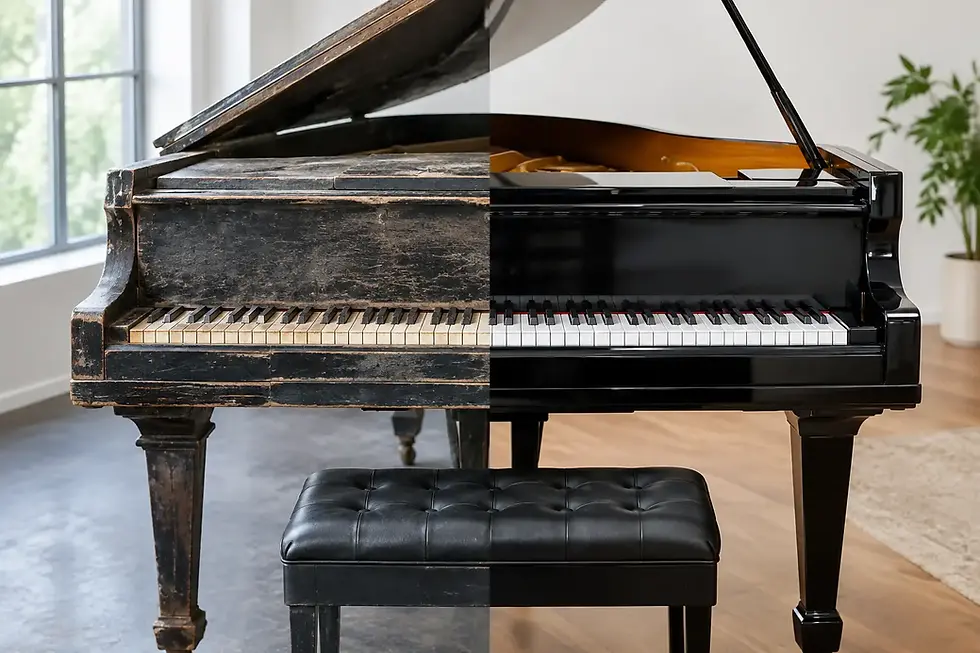
For a smaller room, condition and preparation are often more important than whether a piano is new or refurbished. A carefully restored or properly refurbished upright can be an excellent choice if it has been selected on musical merit and technical integrity rather than cosmetic appeal alone. Equally, a newer instrument may suit a buyer who wants consistency of touch and a clean, modern cabinet.
What matters is honest assessment. The right piano for a compact room is the one that suits the space, the standard of playing and the household's long-term needs. A first piano for a young student may call for something very different from the piano an experienced amateur wants for Schubert in the evening.
When a silent system makes sense
In smaller homes, especially terraces, semis and flats, practice times can become part of the buying decision. In that case, an upright with a well-integrated silent system may be worth considering. It allows the player to practise with headphones while preserving the feel of a real piano action.
This is not necessary for every household, and some pianists prefer the pure acoustic instrument without additions. Still, where neighbours, children’s bedtimes or irregular working hours are a reality, it can make a very good upright far more practical in everyday life.
A better question than “what is the smallest upright?”
The better question is this: which upright will still be enjoyable in five or ten years, in the room you actually live in? That usually leads to a better result than chasing minimum dimensions. The best small-room pianos are not merely compact. They are musically convincing, mechanically sound and civilised in tone.
For most buyers, that means prioritising quality of action, tonal balance and careful preparation over novelty or sheer compactness. If the instrument encourages practice, supports technique and suits the room without overpowering it, you are on the right track.
A small room does not rule out serious piano ownership. It simply asks for better judgement - and a piano chosen with care will reward that every day.

Comments