


How to Choose a Family Piano Well
A family piano often begins with one person’s wish and quickly becomes everyone’s business. One child starts lessons, another taps out film tunes by ear, a parent returns to playing after years away, and suddenly the instrument in the sitting room matters far more than expected. That is why knowing how to choose a family piano properly is less about chasing a particular name and more about finding an instrument that will serve real musical life at home.
A good family piano needs to do several jobs at once. It should invite a beginner to practise, give a more advanced player enough control to develop properly, and sit comfortably in a domestic setting without becoming a burden to live with. Those aims do not always point to the same instrument, so the right choice is rarely the one with the flashiest cabinet or the broadest marketing claims.
How to choose a family piano for real home use
The first question is not upright or grand. It is how the piano will actually be used over the next five to ten years. A family buying for a complete beginner needs something very different from a household where one player is already working at grade exams or beyond.
If the piano is likely to become a central part of family life, it is wise to choose with some headroom. Beginners grow. Hands strengthen. Ears improve. A piano that feels merely acceptable in the first month can become limiting surprisingly quickly if the touch is uneven, the tone thin, or the action unreliable. By contrast, a well-prepared instrument supports progress quietly in the background. It does not get in the way.
This is where expert guidance matters. Families often assume they are choosing furniture with strings attached, when in fact they are choosing a mechanical musical instrument with thousands of moving parts. The visible finish is only a small part of the story.
Start with touch and tone, not appearance
People naturally respond first to what they can see. A polished cabinet, elegant legs, or a compact shape can all be appealing. Yet the lasting value of a piano lies in its touch and tone.
Touch is the way the keyboard responds under the fingers. If it is too heavy, a child may struggle and tire. If it is too light or inconsistent, proper control becomes harder to learn. Good touch should feel even across the keyboard and predictable from note to note. It does not need to be concert-heavy to be useful, but it should encourage sound technique rather than compensate for poor regulation.
Tone is more personal. Some families prefer a warm, rounded sound that blends easily into the home. Others enjoy a brighter, clearer voice. Neither is automatically better. What matters is whether the tone remains pleasant across the whole register and whether it has enough depth to reward regular playing. A piano that sounds brittle in the upper section or muddy in the bass may soon lose its charm.
This is one of the main trade-offs in how to choose a family piano. An instrument can look handsome and still be musically disappointing. Another may appear more modest but offer far better touch, tuning stability and tonal character. The latter is usually the wiser long-term choice.
Upright or grand?
For most family homes, an upright piano is the practical answer. A well-made upright can provide excellent musical value, a satisfying action, and a full enough sound for lessons, home practice and serious enjoyment. It also makes sensible use of space.
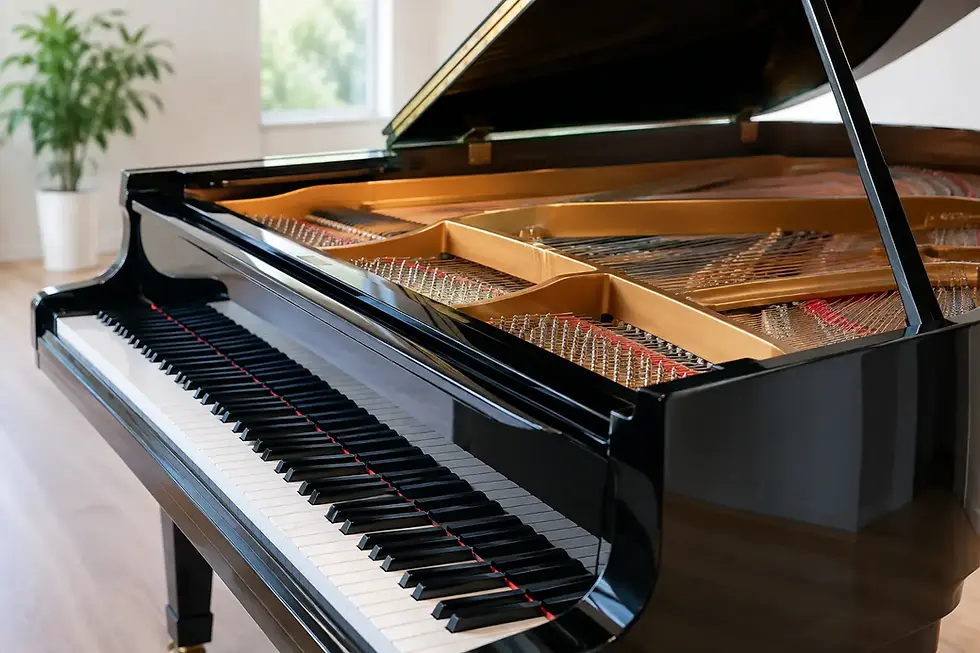
A grand piano offers a different level of tonal projection and action design, and for some advanced pianists it is absolutely the right instrument. But it asks more of the room, both physically and acoustically. In many homes, a grand can dominate the space unless the room genuinely suits it.
Size within the upright category matters more than many buyers realise. Taller uprights tend to offer a richer bass, longer strings and a more substantial musical experience than very compact models. That does not mean the tallest piano is always best. It means the smallest option should not be chosen simply because it tucks neatly into a corner. If the family hopes to live with the piano for years, musical quality should lead and dimensions should follow where possible.
The room matters more than people expect
A piano does not sound the same everywhere. Hard floors, large windows and bare walls can make an instrument feel bright or sharp. Thick carpets, heavy curtains and lots of soft furnishings can take the edge off and sometimes leave the sound feeling slightly closed.
Placement is not just about convenience. Pianos should be kept away from radiators, underfloor heating where possible, draughty doors and direct sunlight. Fluctuations in temperature and humidity are unhelpful for tuning stability and long-term condition. An instrument placed thoughtfully will generally be more reliable and easier to maintain.
This is especially relevant in period houses and open-plan rooms, both common across parts of Surrey and London. A lovely room is not always a friendly environment for a piano unless placement is considered carefully.
New, refurbished, or older?
Families are often unsure whether an older piano is a risk or an opportunity. The answer is that it depends entirely on the individual instrument and the quality of preparation behind it.
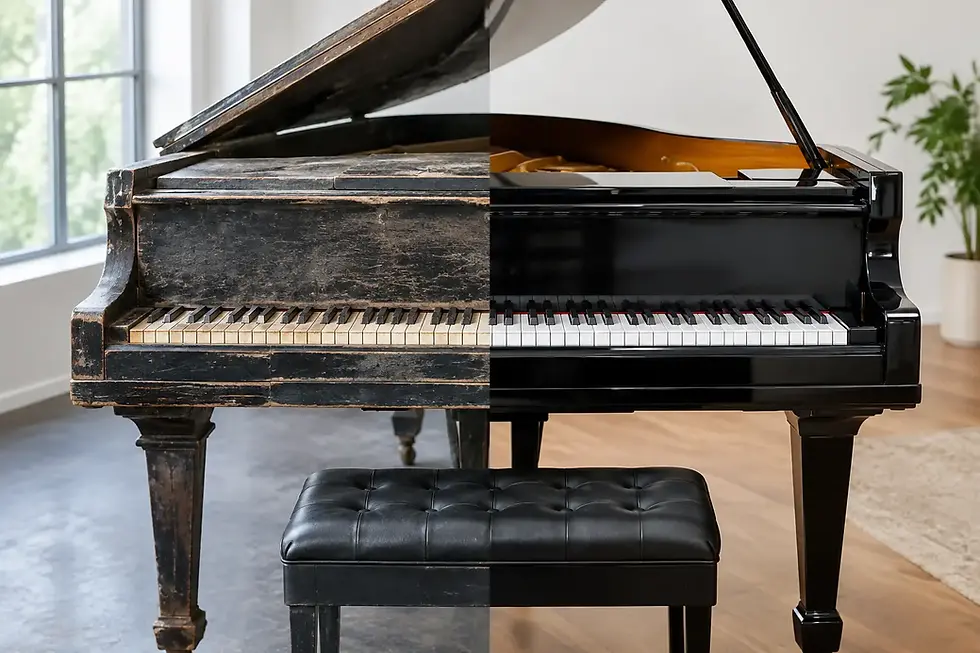
A properly refurbished piano can be an excellent family choice. If the structure is sound and the action has been restored, regulated and voiced with care, an older instrument may offer real musical depth and character. It can also represent a more thoughtful route into piano ownership than buying something selected primarily for showroom appeal.
On the other hand, an untreated older piano can bring avoidable frustration. Sticking notes, uneven touch, poor tuning stability and worn internal parts are not minor inconveniences when a child is trying to learn. They can actively discourage practice. Families should be wary of assuming that any piano which still makes a noise is suitable for study.
The safer question is not the age of the piano but its condition, preparation and musical merit.
Think beyond the first player
A family piano is rarely used by just one person. Even when purchased for a child, it often becomes a shared instrument. That changes the brief.
The keyboard should be responsive enough for learning and expressive enough for better players. The sound should be pleasant at modest volume, because most family playing happens in ordinary domestic life rather than formal performance conditions. Reliability matters enormously. If the piano needs constant coaxing, it stops being a source of pleasure.
There is also an emotional dimension. The right piano tends to draw people towards it. Someone plays after supper. A guest tries a tune. A teenager uses it differently at sixteen than they did at eight. A worthwhile instrument earns its place in the home because it remains musically generous as the household changes around it.
What to look and listen for when you try one
When testing a piano, play the same simple pattern in several areas of the keyboard rather than only the notes you already like. Listen for consistency. One section should not suddenly become harsh or dull without reason.
Try soft playing as well as firm playing. A family piano should not only respond when struck hard. It should also sing quietly. If possible, repeat notes and play a few scales slowly to feel whether the action is even. Beginners may not have the technique to assess this fully, so a more experienced pianist or technician can be invaluable here.
Pedals matter too. They should work cleanly and feel mechanically secure. Small signs of neglect often appear in these details.
Most importantly, do not rush because a piano feels pleasant in the first minute. Better instruments reveal themselves over a little time. They feel composed rather than flashy.
Why aftercare should influence the choice
A piano is not a static purchase. It needs tuning, and from time to time it may need regulation, repairs or voicing to remain at its best. Families choosing a piano should consider whether the instrument is one that can be looked after properly for years rather than merely delivered and forgotten.
This is one reason specialist selection is so valuable. At Runnymede Pianos, the emphasis is not on moving volume but on matching the right instrument to the household, then supporting it with expert care afterwards. For a family, that continuity matters. It is reassuring to know that the person advising on the piano understands both its internal condition and its musical role in the home.
Choose for the life you want around it
The best answer to how to choose a family piano is usually the least theatrical one. Choose the instrument that feels dependable under the fingers, sounds rewarding at home, fits the room sensibly, and has the quality to support progress rather than restrict it. A family piano should not simply fill a space. It should make musical life easier to begin, easier to sustain, and more satisfying to return to year after year.
If you choose with that in mind, the piano is far more likely to become part of the family rather than just another possession in the house.

Comments