

What Makes a Steinway Piano So Distinctive?
- Toby Johnson
- 6 days ago
- 5 min read
A Steinway piano is often spoken of as though the name alone settles every question of musical quality. The reality is more interesting. A fine Steinway can offer exceptional colour, power and control, but each instrument has its own voice, condition and history. Choosing or caring for one well calls for careful listening, sound technical judgement and an understanding of what the pianist needs from it.
For many players, a Steinway represents a long-held ambition: an instrument capable of meeting a developing musician at home, supporting serious study, or filling a recital room with remarkable presence. Its reputation is deserved, yet the best decision is never simply to buy a famous name. It is to find a piano that feels musically right, has been properly assessed and can be maintained to a high standard for years to come.
Why a Steinway piano has its particular character
The distinctive nature of a Steinway lies in the relationship between design, materials and skilled regulation rather than in one isolated feature. The laminated maple rim creates a strong, curved structure around the case. This helps the soundboard and strings work efficiently, allowing the instrument to produce both a broad concert sound and quieter, more intimate shades of tone.
The soundboard, generally made from carefully selected spruce, is central to the piano's musical response. It does not merely make the instrument louder. A responsive soundboard allows the player to shape a note after it has begun, through touch, pedalling and voicing. This is one reason accomplished pianists value a piano that can remain singing and clear at a soft dynamic, while retaining authority when played with greater weight.
Scale design also has a great deal to do with the result. String lengths, tensions and the point at which strings cross are calculated to bring the registers together. On a well-prepared grand, the transition from bass to tenor and through the middle register should feel coherent rather than abrupt. The bass should possess depth without clouding the harmony, and the treble should project without becoming hard or thin.
No two examples are identical. Wood is a natural material, hammers develop differently over time, and the condition of the action affects what the pianist experiences at the keys. That individuality is not a flaw. It is precisely why a particular instrument should be played and examined in person wherever possible.
The touch matters as much as the tone
When people first describe a fine piano, they commonly mention its sound. Yet the action is often what makes a player return to it. The action is the complex mechanism that transfers motion from the key to the hammer, allowing repetition, control and nuance. On a properly regulated Steinway, the keys should feel even from one end of the keyboard to the other, with a clear point of engagement and dependable repetition.
A refined action does not necessarily mean an unusually light action. Some pianists prefer a little more resistance, particularly when practising repertoire that demands control at the edge of a quiet sound. Others seek a more immediate, yielding response. The right feel depends on the player, the repertoire and the intended use of the piano.
Regulation is therefore not a cosmetic adjustment. Key height, key dip, hammer travel, let-off, drop and repetition must work together. Small inaccuracies can make a distinguished instrument feel heavy, uneven or unpredictable. In contrast, careful regulation allows the player to concentrate on phrasing and tone rather than compensating for the mechanism.
Choosing between a grand and an upright
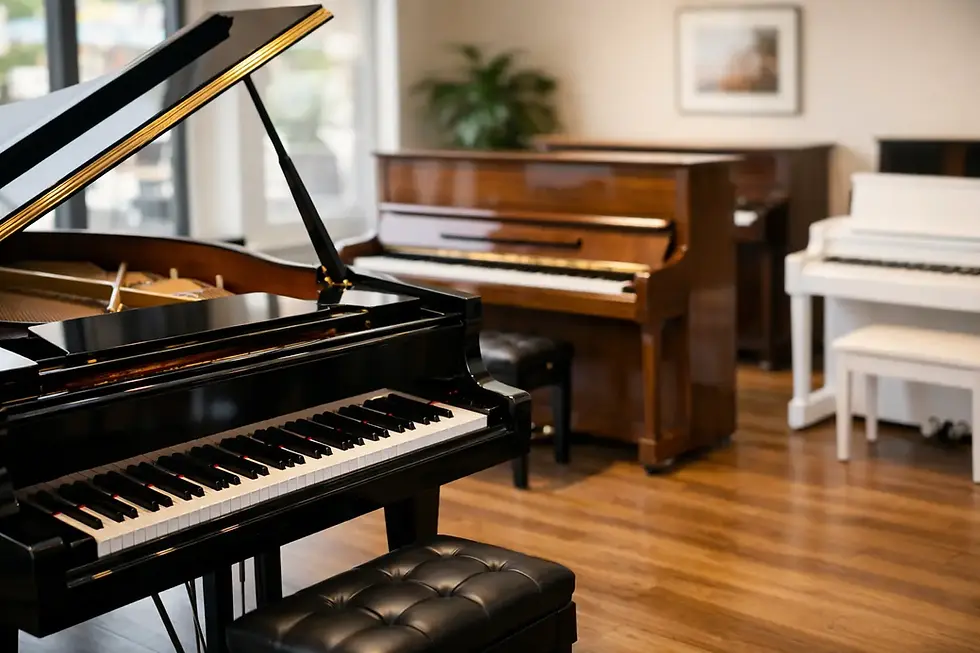
Steinway grand pianos are renowned for their musical range, particularly in medium and larger sizes. A grand action benefits from gravity-assisted hammer return, which can offer very rapid repetition and a broad palette of sound. It is an excellent choice for advanced players, teaching studios and homes where space and acoustics allow the instrument to breathe.
An upright can nevertheless be an entirely serious musical instrument. A well-made upright occupies less floor space and may suit a family room, flat or teaching space more naturally. The decision should account for the room, not simply the available footprint. A grand in a small, highly reflective room can dominate the space, while an upright in a generous room may not provide the depth of sound a committed pianist wants.
It is also worth considering who will play it. A young beginner needs a stable, responsive keyboard and a pleasing tone that encourages regular practice. An experienced pianist may be more concerned with tonal reserve, repetition and the ability to control very soft playing. A piano should serve the musical life of the household as it is now, while allowing room for it to develop.
A used Steinway piano needs informed assessment
Older Steinways can be exceptional instruments. They can also conceal wear that is not apparent in a polished case or a freshly tuned scale. Age alone does not determine quality. The relevant questions concern structural condition, previous repairs, action wear, string condition, pinblock security, soundboard health and the standard of any restoration work.
A sympathetic restoration can return a worthy piano to excellent musical service. Replacement strings, hammers, dampers and action components may be appropriate where wear has compromised performance. However, restoration is not a single, uniform state. The quality of workmanship, the suitability of the materials and the final regulation and voicing all matter. A piano described as restored should invite further questions, not end them.
Original parts are not automatically preferable if they are worn beyond reliable use. Equally, new parts do not guarantee a satisfying instrument if they have been poorly fitted or insufficiently prepared. The objective is a piano that is structurally secure, musically expressive and dependable in daily use.
A proper inspection should include more than a brief performance. The technician needs to assess the case and structure, examine the soundboard and bridges, test tuning stability, inspect the action and listen critically across the whole compass. For a buyer, this independent expertise can turn a decision based on appearance and reputation into one based on genuine musical value.
Preparation is what allows quality to be heard
Even an excellent Steinway will not show its best without regular specialist attention. Tuning is essential, but it is one part of a wider programme of care. Changes in humidity affect the wooden structure and alter string tension. Seasonal movement can influence tuning, action regulation and the efficiency of the dampers.
Voicing is another important consideration. Over time, hammers compact through playing and may produce a brighter, more percussive sound. Judicious voicing can restore warmth and range without removing the clarity that gives the piano character. This must be approached with restraint. Excessive softening can leave the tone unfocused, while neglect can allow it to become harsh.
For a piano used by several family members, in a school, or for regular entertaining, a planned maintenance schedule is especially valuable. Minor issues are easier to resolve before they affect playability or lead to more extensive work. Reliable care protects both the instrument and the pleasure people take in sitting down to play it.
Listening beyond the name on the fallboard
A Steinway should be judged with the ears and hands, not simply by its badge. Play slow scales at a quiet dynamic, then chords across the registers. Listen for an even tonal journey from bass to treble. Test repeated notes, soft playing and gradual crescendos. Notice whether the sustain pedal supports the sound cleanly and whether the dampers stop it precisely.
If possible, ask another pianist to play while you listen from elsewhere in the room. The sound at the keyboard and the sound heard by an audience are not always the same. A piano that feels wonderfully immediate under the hands may project more brightly than expected into a hard-surfaced room; another may reveal a richer warmth from several feet away.
The finest instruments reward attention over time. Whether a Steinway is a cherished family piano, a serious practice instrument or the centrepiece of a performance space, expert care gives its musical qualities the best chance to speak clearly, honestly and for many years.


Comments